
A Pilot Proposal for Continental Convergence and Integration
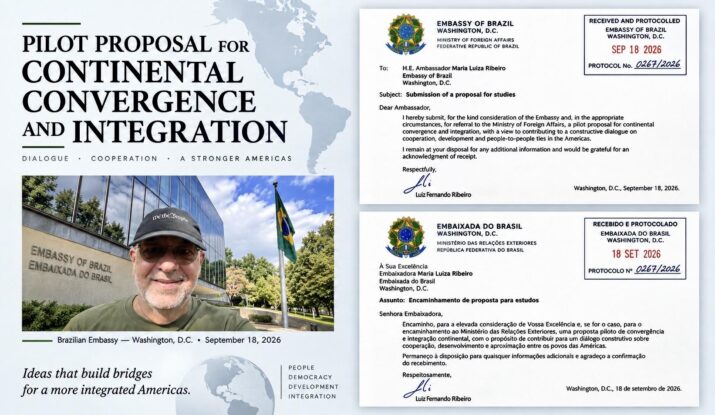
On September 18, 2026, two formal letters accompanying the Open Letter and Manifesto proposing a pilot initiative for continental convergence and integration were officially submitted in Washington, D.C. — one to the United States Department of State, addressed to Secretary of State Marco Rubio, and the other to the Embassy of Brazil, addressed to Foreign Minister Mauro Vieira through Ambassador Maria Luiza Ribeiro Viotti.
The initiative proposes that Brazil and the United States consider, as an initial and non-binding step, the creation of a bilateral framework to study possibilities for greater continental convergence and integration, while fully preserving national sovereignty, reciprocity, and the independence of each participating nation.
The two letters are reproduced below as part of a commitment to transparency and public discussion.
The complete Open Letter and Manifesto may be read here:
https://oticadarazao.com/open-letter-and-manifesto-to-the-governments-of-united-states-and-brazil/
_______________________
The Honorable Marco Rubio
Secretary of State
United States Department of State
Washington, D.C.
September 18, 2026
Subject: Open Letter and Manifesto — A Reflection on U.S.–Brazil Relations and the Future of the Americas
Note: This Manifesto is being simultaneously submitted to the attention of Brazil’s Minister of Foreign Affairs, Mauro Vieira, in the same spirit of bilateral, convergent, and nonpartisan reflection.
Dear Secretary Rubio,
I respectfully submit for your consideration the attached Open Letter and Manifesto entitled “Proposal for a Union of Sovereign Nations of the Americas,” conceived as a personal contribution to reflection on possible ways to strengthen relations between the United States and Brazil and, potentially, to explore a broader form of continental convergence in the future.
I hope that the nature and scope of the proposal may encourage a thoughtful and dispassionate reading within diplomatic and governmental circles.
The document was not conceived as a partisan initiative, nor as an argument on behalf of any particular administration. I have deliberately framed it as a matter of State, grounded in voluntary integration, full preservation of national sovereignty, technical study, reciprocity, and gradual convergence.
The present moment in U.S.–Brazil relations appears particularly relevant to such a reflection. The renewal of bilateral dialogue demonstrates that even in the presence of significant disagreements, channels of communication can be preserved and mutually beneficial solutions can still be pursued.
Perhaps therein lies an even greater opportunity: not merely to manage disagreements, but to ask whether a genuinely constructive disposition might transform some of them into starting points for stronger, more predictable, and more enduring relations.
In that spirit, the Manifesto recalls a lesson I retained from my studies of Diplomatic Law at the University of Brasília, conveyed by the distinguished late Brazilian Ambassador José Oswaldo de Meira Penna:
“True diplomatic intelligence must promote convergence and circumscribe divergences.”
The reference is not merely historical. It expresses the principle underlying the entire proposal: peoples and States do not need to agree on everything in order to rationally build together what may serve their common interests.
There are also, in this reflection, echoes of teachings I received during my academic formation at the University of Brasília and through contact with professors and diplomats associated with Brazil’s diplomatic tradition, among them former Foreign Minister and Ambassador Rubens Ricupero, Ambassador Márcio Cambraia, Francisco Rezek, Professor Litton Leite Guimaraes, and Professor José Carlos Brandi Aleixo, as well as other teachers whose intelligence and experience helped shape in me an appreciation for prudence, convergence, and the search for reasonable solutions.
Perhaps for that reason, this proposal emerged less as a preconceived political construction than as the natural result of a way of looking at relations among States: seeking what can bring them closer without requiring their differences to disappear.
The Letter therefore suggests something deliberately modest as a first step: possible consideration of a Brazil–United States Bilateral Commission for Studies on Continental Convergence and Integration.
It asks for no advance commitment to any particular model, no transfer of sovereignty, and no predetermined political obligation.
Quite the opposite.
As stated in the Manifesto itself:
“I do not propose that the Brazilian and American governments accept this conclusion today. I propose something much simpler and more responsible: that they decide to study it.”
This is not intended to present a finished solution, much less to suggest that an idea of this nature should prevail simply because of personal conviction.
It is merely an effort to offer, in a constructive and unpretentious spirit, a reflection that seems sufficiently grounded to deserve examination.
Its merits, limitations, and possible usefulness properly belong to the judgment of those to whom society has entrusted responsibilities of State.
Having perceived what I consider a potentially relevant possibility, I also felt an elementary responsibility of citizenship: not to remain silent when a good-faith reflection, grounded in reason, might contribute to the consideration of paths that have not yet been sufficiently explored.
It is exclusively in that spirit that I submit it.
I have no expectation of a response, recognition, or acceptance of the proposal.
Presenting it simply fulfills what I regard as a moral and civic responsibility not to keep to myself an idea that might, perhaps, contribute in some measure to the enduring interests of States and their societies.
From that point forward, its future should belong exclusively to the merit of the idea itself and to the judgment of those willing to examine it.
Nothing more is intended: a reasonable, open, and unpretentious suggestion, submitted to the intelligence, experience, and institutional judgment of those who may consider it worthy of examination.
If its reading produces at least one question — “Is this possibility worth studying?” — then the initial purpose of this contribution will already have been fully achieved.
Respectfully,
Samuel Sales Saraiva
Brazilian and American citizen, with civic and personal ties to both nations.
E-mail: samuelsalessaraiva@gmail.com
______________________________________
Excelentíssimo Senhor Ministro Mauro Vieira
Ministro de Estado das Relações Exteriores
Por intermédio de Sua Excelência a Senhora Embaixadora Maria Luiza Ribeiro Viotti
Embaixada do Brasil em Washington, D.C.
Olney, MD, 18 de Setembro de 2026
Assunto: Encaminhamento de Carta Aberta e Manifesto — proposta de estudos sobre convergência e integração continental
Nota: Este Manifesto está sendo igualmente submetido ao conhecimento do Secretário de Estado dos Estados Unidos, Marco Rubio, como expressão do mesmo propósito de reflexão bilateral, convergente e não partidária.
Por intermédio da Embaixada do Brasil em Washington, permito-me encaminhar a Vossa Excelência a Carta Aberta e Manifesto intitulada “Proposta de uma União de Países Soberanos das Américas”, concebida como uma contribuição pessoal à reflexão sobre possibilidades de fortalecimento das relações entre Brasil e Estados Unidos e, eventualmente, de uma futura convergência continental mais ampla.
Espero que as características e o alcance da proposta possam favorecer uma leitura serena em ambiente diplomático e governamental.
O documento não foi concebido como proposição partidária, nem como defesa de determinado governo. Procurei formulá-lo deliberadamente como reflexão de Estado, fundada em integração voluntária, preservação integral da soberania nacional, estudo técnico, reciprocidade e convergência gradual.
O atual momento das relações entre Brasil e Estados Unidos parece conferir particular relevância a essa reflexão. A retomada do diálogo bilateral demonstra que, mesmo diante de divergências importantes, permanece possível preservar canais de interlocução e buscar soluções mutuamente benéficas.
Talvez exista precisamente aí uma oportunidade maior: não apenas administrar divergências, mas perguntar se uma predisposição verdadeiramente construtiva poderia transformar algumas delas em pontos de partida para relações mais sólidas, previsíveis e duradouras.
Nesse espírito, recordo no Manifesto uma lição que conservei de meus estudos de Direito Diplomático na Universidade de Brasília, transmitida pelo saudoso e eminente embaixador brasileiro José Oswaldo de Meira Penna:
“À verdadeira inteligência diplomática cabe promover convergências e circunscrever divergências.”
A referência não é meramente histórica. Ela procura sintetizar o princípio que orienta toda a proposta: povos e Estados não precisam concordar em tudo para construir racionalmente aquilo que pode beneficiá-los em comum.
Há também, nesta reflexão, ecos de ensinamentos recebidos ao longo de minha formação na Universidade de Brasília e do contato acadêmico com professores e diplomatas ligados à tradição diplomática brasileira, entre eles o ex-ministro das Relações Exteriores e embaixador Rubens Ricupero, o embaixador Márcio Cambraia, Prof. Lirrton Leite Guimarães, Francisco Rezek e o professor José Carlos Brandi Aleixo, além de outros mestres cuja inteligência e experiência contribuíram para desenvolver em mim a valorização da ponderação, da convergência e da busca de soluções razoáveis.
Talvez por isso esta proposta tenha surgido menos como uma construção política previamente imaginada e mais como consequência natural de uma forma de observar as relações entre Estados: procurando aquilo que pode aproximar sem exigir que desapareçam as diferenças.
A Carta sugere, portanto, algo deliberadamente modesto em seu primeiro passo: a eventual criação de uma Comissão Bilateral Brasil–Estados Unidos de Estudos sobre Convergência e Integração Continental.
Não se propõe adesão antecipada a qualquer modelo, transferência de soberania ou compromisso político previamente definido.
Ao contrário.
Como afirmo no próprio Manifesto:
“Não proponho que os governos brasileiro e americano aceitem hoje essa conclusão. Proponho algo muito mais simples e responsável: que decidam estudá-la.”
Não se trata, naturalmente, de apresentar uma solução acabada, muito menos de sugerir que uma ideia dessa natureza deva prevalecer por força de convicção pessoal.
Trata-se apenas de oferecer, com espírito construtivo e despretensioso, uma reflexão que me parece suficientemente fundamentada para merecer exame.
Seus méritos, suas limitações e sua eventual utilidade pertencem legitimamente à avaliação daqueles a quem a sociedade confiou responsabilidades de Estado.
Ao perceber uma possibilidade que considero relevante, entendi também existir um dever elementar de cidadania: não permanecer omisso diante de uma reflexão que, apresentada de boa-fé e fundada na razão, talvez possa contribuir para o exame de caminhos ainda não suficientemente considerados.
É exclusivamente nesse espírito que a submeto.
Não há, de minha parte, expectativa de resposta, reconhecimento ou acolhimento da proposta.
Apresentá-la cumpre apenas aquilo que considero uma responsabilidade moral e cívica de não guardar para mim uma ideia que possa, eventualmente, oferecer alguma contribuição ao interesse permanente dos Estados e de suas sociedades.
A partir daí, seu destino deve pertencer exclusivamente ao mérito da própria ideia e ao discernimento daqueles que tenham disposição para examiná-la.
Nada além disso é pretendido: uma sugestão razoável, leve, aberta ao contraditório e submetida à inteligência, à experiência e ao julgamento institucional de quem considere oportuno conhecê-la.
Se sua leitura produzir ao menos uma pergunta — “vale a pena estudar esta possibilidade?” — o objetivo inicial desta contribuição já terá sido plenamente alcançado.
Com elevada consideração e respeito,
Samuel Sales Saraiva
Cidadão brasileiro e estadunidense, com vínculos cívicos e afetivos com ambas as nações.
Washington, D.C.
Estados Unidos da América
E-mail: samuelsalessaraiva@gmail.com
https://oticadarazao.com/