
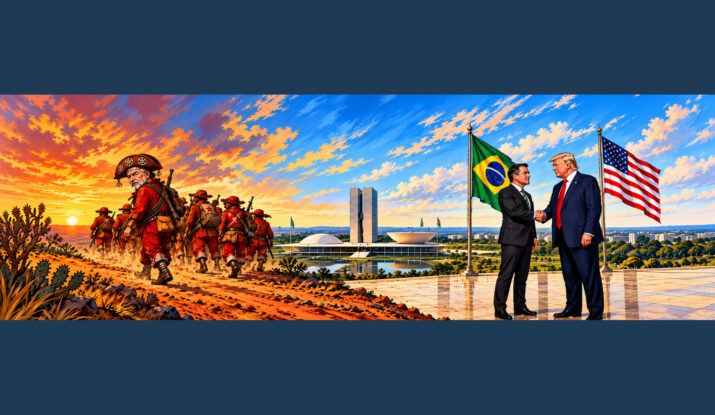
A potential political convergence between Brasília and Washington opens the way to examine an alliance of sovereign nations, encompassing economic integration, the possible adoption of shared monetary arrangements, and multilateral security cooperation.
By Samuel Sales Saraiva
Washington, D.C., October 12, 2026
English-language courtesy copies (Cc):
The Honorable Donald J. Trump
President of the United States
The White House
The Honorable Marco Rubio
Secretary of State of the United States
U.S. Department of State
By Samuel Sales Saraiva
Washington, D.C., October 12, 2026
English-language courtesy copies (Cc):
- The Honorable Donald J. Trump, President of the United States | The White House
- The Honorable Marco Rubio, Secretary of State of the United States | U.S. Department of State
Dear Senator Flávio Bolsonaro,
The results of the first round of Brazil’s 2026 presidential election offer an opportunity to reflect on the course the country may choose for its political, economic, and diplomatic future.
Your substantial electoral support reveals the extent of a segment of Brazilian society that seeks changes in the conduct of national affairs and places its hopes in an alternative government. Regardless of the legitimate differences inherent in the democratic process, this movement deserves to be understood as a political expression whose significance cannot be ignored.
It is against this backdrop that I believe it timely to present a proposal extending beyond the electoral contest and addressing the enduring interests of Brazil, the United States, and the other nations of the Americas.
I. A Diplomatic Proposal Met with Silence
On September 18, 2026, I formally submitted to the U.S. Department of State and the Embassy of Brazil in Washington, D.C., an Open Letter and Manifesto to the Governments of the United States and Brazil, proposing the establishment of a bilateral commission to examine the feasibility of a future Inter-American Union of Sovereign Nations.
The documentation was addressed to U.S. Secretary of State Marco Rubio and Brazilian Minister of Foreign Affairs Mauro Vieira, through Ambassador Maria Luiza Ribeiro Viotti.
The proposal did not request immediate adherence to any model of integration, nor did it call for predefined political, economic, or institutional commitments. It proposed something substantially simpler: that the two governments consider the merits of jointly studying opportunities for strategic cooperation capable of expanding development, security, prosperity, and voluntary integration among sovereign countries.
Yet, as of this date, I have received no response from Brazil’s diplomatic representation concerning the merits of the initiative or any action that might be taken on it. Although silence does not formally amount to rejection, from the perspective of someone legitimately exercising the right to civic participation, it speaks eloquently through the absence of any expressed consideration.
It is particularly regrettable that an initiative submitted in good faith, without personal demands and grounded in long-term interests, did not merit even an acknowledgment of receipt or an indication that it would be examined. Diplomacy does not exist merely to represent governments. Its institutional responsibilities include safeguarding the enduring interests of the state and maintaining channels of communication with society. When a diplomatic mission remains silent in the face of a citizen’s contribution, it forfeits, at the very least, an opportunity to demonstrate openness to dialogue and respect for public participation.
I do not contend that the proposal was rejected for ideological reasons, as I do not know the internal motivations of Brazil’s diplomatic representation. I do, however, place one fact on record: the absence of any response known to me, leaving its political and institutional significance to the judgment of readers.
II. Governments Come and Go; National Interests Endure
One of the most damaging distortions in the conduct of state affairs is the confusion of enduring national interests with transient ideological preferences. Governments are temporary; nations endure.
Relations between Brazil and the United States should not depend exclusively on the personal, partisan, or ideological affinities of their leaders. The two societies share economic, scientific, technological, energy, environmental, migration-related, and strategic interests whose significance extends beyond any single presidential term. Bilateral rapprochement should therefore be understood as a policy potentially beneficial to both countries, not as an ideological concession.
International experience demonstrates that political differences need not prevent economically productive and institutionally responsible agreements. In this regard, I retain a lesson from my studies of Diplomatic Law at the University of Brasília, imparted by the late Brazilian Ambassador José Oswaldo de Meira Penna:
“True diplomatic intelligence must foster convergence and contain divergence.”
Few formulations capture so well the principle that should guide relations among mature nations. Genuine diplomatic competence is measured not by the ability to multiply antagonisms, but by the intelligence to recognize shared interests without requiring differences to disappear.
III. An Inter-American Union of Sovereign Nations
The proposal I present does not seek to create a supranational organization to which Brazil, the United States, or any other country must surrender its sovereignty. On the contrary, it begins with the recognition that sovereignty is an indispensable foundation of any legitimate association among states.
The experience of the European Union offers important points of reference, both in its achievements and in the difficulties it continues to face. The Americas, naturally, have historical, legal, cultural, and economic characteristics that require solutions of their own.
I therefore suggest the establishment of a Brazil–United States Bilateral Commission for the Study of Continental Convergence and Integration, comprising government representatives, diplomats, legal scholars, economists, scientists, universities, and experts in strategic fields.
Its work could examine possibilities for cooperation in trade, investment, infrastructure, energy, scientific development, artificial intelligence, continental security, education, human mobility, and reciprocal protection of rights. It could also assess, without prior commitments, the costs, risks, and benefits of monetary arrangements—including options involving the U.S. dollar—and of multilateral security mechanisms.
Other interested nations could subsequently join the process voluntarily, with full respect for their respective constitutions, identities, and sovereign prerogatives. There would be no advance commitments to political union, a common currency, unrestricted opening of borders, or transfers of national powers. Everything would depend on studies, assessments, negotiations, and decisions legitimately adopted by the participating countries.
The aim is not to diminish national sovereignty, but to strengthen nations’ ability to achieve results through voluntary cooperation.
IV. The Prospect of Renewed Convergence Between Brasília and Washington
A possible change in the direction of Brazil’s government could create different political conditions for deepening dialogue with the United States. The prospect of greater affinity between the leaders of the two countries is no automatic guarantee of diplomatic success, but it could facilitate the identification of common interests and the opening of institutional channels for new initiatives.
It is precisely in this context that the integration proposal deserves consideration. A convergence of purpose among leaders could offer an opportunity to turn temporary political affinities into lasting structural commitments. Yet a genuinely strategic vision requires that the intended benefits not depend solely on particular leaders remaining in office.
The objective must be to build mechanisms capable of surviving electoral changes and serving future generations. The great opportunity lies not merely in bringing politically like-minded governments closer together, but in establishing institutional foundations enabling Brazil and the United States to cooperate even when their governments disagree.
This distinction separates diplomacy driven by circumstances from genuine statecraft.
V. A Responsibility Toward Brazilians Living Abroad
The discussion of continental integration also has a profoundly human dimension.
Thousands of Brazilians live in the United States, work, raise families, contribute economically, and maintain emotional and material ties with Brazil. A significant portion of this population faces immigration difficulties, legal uncertainty, or limitations related to mobility and the stability of their residency status.
A more constructive bilateral relationship could encourage studies of reciprocal protection mechanisms, lawful mobility, consular cooperation, and the gradual expansion of safeguards, always with respect for national laws. Why restrict diplomatic reciprocity to imposing limitations when it could also be used to expand opportunities and legal certainty?
Human dignity should not be treated as secondary to short-term political interests. Diplomacy that aspires to genuine effectiveness must consider not only the interests of governments, but also the actual living conditions of the citizens it represents.
VI. A Citizen’s Contribution, Not a Personal Claim
Senator Flávio Bolsonaro,
The proposal presented here does not arise from business interests, partisan ambitions, or expectations of personal recognition. It arises from reflections developed over many years of observing international relations, from a life lived among different societies, and from the conviction that human intelligence should devote more attention to building common ground than to perpetuating antagonisms.
As a citizen of both Brazil and the United States, I maintain deep ties to both nations and recognize the extraordinary capacity for cooperation they could develop. I do not claim absolute originality for the idea of continental rapprochement, whose historical roots can be traced to various integrationist experiences and schools of thought. What I propose is to submit it once again to institutional examination in a political context potentially more favorable to bilateral dialogue.
This initiative also draws philosophical foundations from my book The Age of Reason — The Convergence of Intelligences Under Ethical Safeguards, published in eight languages, with a foreword by former Senator Álvaro Dias, and made available in full, free of charge. Its central argument is that technological progress and the expansion of knowledge acquire genuine civilizational meaning only when accompanied by ethical responsibility, discernment, and a willingness to cooperate.
Politics and diplomacy should be no exceptions to this principle.
VII. The Future Need Not Remain a Prisoner of Today’s Divisions
The Brazilian election results, still subject to the voters’ final decision, open the way to debate different visions of the future. Should you assume the Presidency of the Republic, you will bear the responsibility of representing not only those who supported you at the polls, but Brazilian society as a whole.
It is in this spirit that I submit this contribution for your consideration and that of your prospective advisers in foreign policy, economic integration, and international strategic relations.
I do not ask that the proposal be accepted in advance. I ask only that its foundations be examined, that its feasibility be assessed by technically qualified individuals, and that its potential advantages and limitations be evaluated with intellectual independence.
An idea need not be embraced simply because it has been presented. Nor should it be ignored before its merits are understood.
The silence of Brazil’s diplomatic representation regarding the initiative submitted to the Lula government should not determine the fate of a reflection that belongs, by its very nature, to the debate over the nation’s enduring interests.
The historical moment may change. Opportunities, however, materialize only when there is a willingness to study them. May any renewal of government also bring a renewed capacity to listen, examine, and build.
Perhaps that is precisely the first step toward enabling the Americas to view their borders not merely as lines of separation, but as opportunities for cooperation, reciprocity, and shared development.
- Not an America made subordinate.
- Not an America stripped of its diversity.
- Not an America held captive by ideological antagonisms.
But a community of sovereign nations mature enough to understand that preserving their identities does not prevent them from voluntarily building a better shared future.
With institutional respect and confidence in humanity’s capacity to turn reflection into progress,
Samuel Sales Saraiva
Journalist and writer
Brazilian and American citizen
The Lens of Reason / A Ótica da Razão
Supporting Documentation and References
Supporting Documentation and References
The documents below are provided as background for examining the proposal, for public consultation, and for possible institutional studies:
1. Open Letter and Manifesto to the Governments of Brazil and the United States
Original proposal to establish a bilateral commission to study options for continental integration among sovereign countries.
- Original proposal in English: Open Letter and Manifesto to the Governments of the United States and Brazil
- Diplomatic record in English: Uniting the Americas Without Surrendering Sovereignty — Formal Submission and Transmission of the Proposal
2. The Age of Reason — The Convergence of Intelligences Under Ethical Safeguards
Philosophical work by Samuel Sales Saraiva, with a foreword by former Brazilian Senator Álvaro Dias, published in eight languages and made available free of charge.
- English edition: The Age of Reason — Full Text
3. Artificial Intelligence, Technological Innovation, and Intellectual Property
Publications addressing the convergence of intelligences, ethical responsibility in technological development, and the innovation initiatives mentioned by the author.
- Reference I — Letter to AI leaders: Open Letter to the Leaders and Architects of Artificial Intelligence
- Reference II — Philosophical and technological foundations: The Convergence of Intelligences
- Reference III — Citizen initiative and public responsibility: When an Ordinary Citizen Decides Not to Remain Silent
The technical foundations of initiatives subject to patent protection may be made available for potential institutional
PORTUGUÊS
Carta Aberta a Flávio Bolsonaro: Uma Oportunidade Histórica Diante do Silêncio Diplomático de Lula
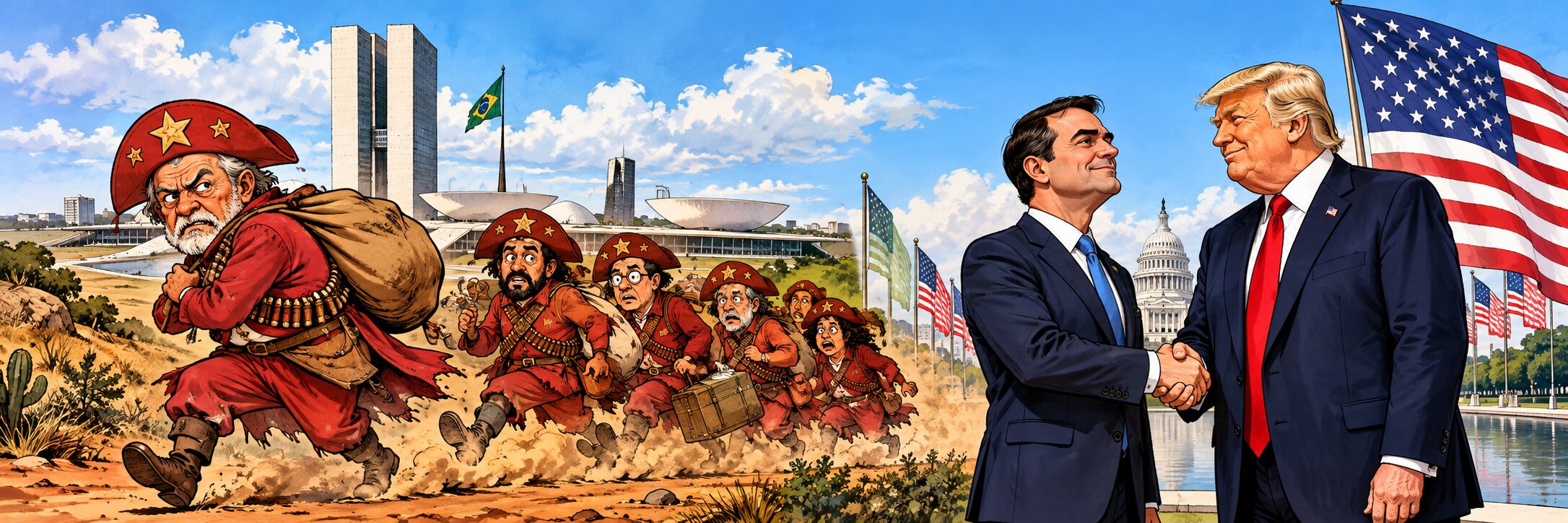
A possível convergência política entre Brasília e Washington abre espaço para uma aliança de nações soberanas, pautada pela integração econômica, eventual cooperação monetária e segurança multilateral.
Por Samuel Sales Saraiva
Washington, D.C., 12 de outubro de 2026
Cópias informativas em inglês (Cc):
- The Honorable Donald J. Trump, President of the United States (The White House)
- The Honorable Marco Rubio, Secretary of State of the United States (U.S. Department of State)
Senhor Senador Flávio Bolsonaro,
O resultado do primeiro turno das eleições presidenciais de 2026 convida a uma reflexão profunda sobre os rumos políticos, econômicos e diplomáticos do Brasil. Sua expressiva votação reflete os anseios de uma parcela expressiva da sociedade que busca renovação na condução do país e deposita expectativas em um novo projeto de governo. Independentemente das naturais divergências do pleito democrático, trata-se de um movimento cuja relevância exige pleno reconhecimento.
É nesse cenário que submeto à sua apreciação uma proposta que transcede a disputa eleitoral e se projeta sobre os interesses de longo prazo do Brasil, dos Estados Unidos e do continente americano.
I. Uma proposta diplomática diante do silêncio institucional
Em 18 de setembro de 2026, encaminhei formalmente ao Departamento de Estado norte-americano e à Embaixada do Brasil em Washington, D.C., a Carta Aberta e Manifesto aos Governos dos Estados Unidos e do Brasil. O documento propunha a criação de uma comissão bilateral para analisar a viabilidade de uma União Interamericana de Países Soberanos. A iniciativa foi dirigida ao Secretário de Estado dos EUA, Marco Rubio, e ao Ministro das Relações Exteriores do Brasil, Mauro Vieira, por intermédio da Embaixadora Maria Luiza Ribeiro Viotti.
A proposta não exigia adesão imediata a modelos rígidos de integração ou compromissos prévios. Propunha algo bem mais ponderado: que ambos os governos avaliassem a conveniência de estudar parcerias estratégicas voltadas ao desenvolvimento, à segurança, à prosperidade e à cooperação voluntária entre nações soberanas.
Contudo, até o momento, a representação diplomática brasileira não emitiu qualquer manifestação sobre o mérito ou o encaminhamento do projeto. O silêncio, embora não represente formalmente uma recusa, soa como uma omissão lamentável diante do direito legítimo de participação cívica. É de se lamentar que uma contribuição feita de boa-fé, pautada no interesse público e sem pleitos pessoais, não tenha recebido sequer uma confirmação de recebimento.
A diplomacia não existe apenas para servir a governos passageiros; sua missão institucional é preservar os interesses permanentes do Estado e dialogar com a sociedade. Quando um órgão diplomático se cala diante de uma contribuição cidadã, desperdiça-se uma oportunidade valiosa de demonstrar abertura e respeito público.
Sem julgar as motivações internas da embaixada, registro o fato objetivo de sua omissão, cuja avaliação política e institucional deixo ao bom senso do leitor.
II. Os governos passam; os interesses nacionais permanecem
Um dos equívocos mais danosos à gestão estatal é confundir o interesse público permanente com preferências ideológicas temporárias. Governos se alternam; as nações permanecem.
As relações entre Brasil e Estados Unidos não devem se limitar às afinidades partidárias de seus governantes. Ambos os países compartilham laços estratégicos — econômicos, tecnológicos, energéticos, ambientais, migratórios e de segurança — cuja relevância supera qualquer mandato. Portanto, a aproximação bilateral é uma política de Estado benéfica e pragmática, não uma concessão política.
Conforme destacava o saudoso embaixador José Oswaldo de Meira Penna em minhas aulas de Direito Diplomático na Universidade de Brasília:
“À verdadeira inteligência diplomática cabe promover convergências e circunscrever divergências.”
Essa premissa sintetiza o verdadeiro espírito da diplomacia madura: identificar pontos de convergência sem exigir a anulação das diferenças.
III. Uma União Interamericana de Países Soberanos
A proposta não busca criar um superestado ou uma autoridade supranacional à qual o Brasil ou os Estados Unidos submetam suas soberanias. Pelo contrário, parte do princípio de que a soberania é o alicerce insubstituível de qualquer aliança legítima.
Inspirando-se nas lições — e também nos limites — do modelo europeu, as Américas devem formular soluções condizentes com suas particularidades históricas e jurídicas. Nesse sentido, proponho a criação da Comissão Bilateral Brasil–Estados Unidos de Estudos sobre Convergência e Integração Continental, composta por representantes públicos, diplomatas, juristas, economistas, cientistas e acadêmicos.
Essa comissão atuaria no estudo de cooperação técnica e estratégica em áreas essenciais: comércio, infraestrutura, energia, inteligência artificial, segurança continental, mobilidade humana e garantias mútuas de direitos. Poderia também analisar, sem compromissos vinculantes, a viabilidade e os custos de acordos monetários — incluindo hipóteses de uso do dólar norte-americano — e mecanismos multilaterais de segurança.
Eventualmente, outras nações do continente poderiam aderir voluntariamente ao processo, respeitando rigorosamente suas Constituições e prerrogativas. Não haveria transferência de competências nacionais nem metas compulsórias; tudo dependeria do livre arbítrio e do rigoroso exame técnico dos países participantes.Trata-se de fortalecer a capacidade de ação das nações por meio da cooperação, sem jamais enfraquecer sua soberania.
IV. A oportunidade de uma nova convergência estratégica
Uma eventual mudança de diretriz no governo brasileiro criará um novo ambiente político para o diálogo com Washington. Embora a afinidade ideológica entre lideranças não garanta por si só o sucesso diplomático, ela facilita a abertura de canais de negociação.
Este é o momento adequado para considerar a integração continental. A harmonia política conjuntural deve ser aproveitada para consolidar avanços estruturais permanentes, construindo pontes e instituições capazes de resistir às mudanças eleitorais e servir às futuras gerações.
A verdadeira visão estratégica consiste em garantir que Brasil e Estados Unidos continuem a cooperar de forma sólida, independentemente de quem ocupe o poder.
V. A dimensão humana e a responsabilidade com os brasileiros no exterior
A integração das Américas possui, acima de tudo, um compromisso com as pessoas. Centenas de milhares de brasileiros residem nos Estados Unidos, onde trabalham, constroem famílias e contribuem para a economia local sem perder os vínculos com sua pátria. Muitos enfrentam desafios de regularização migratória e incertezas jurídicas.
Uma diplomacia bilateral proativa e madura pode estruturar acordos de mobilidade legal, proteção consular e ampliação de garantias normativas recíprocas. Em vez de restringir a reciprocidade à imposição de barreiras, devemos usá-la para gerar oportunidades e estabilidade jurídica aos cidadãos.
A eficácia diplomática também se mede pelo impacto positivo na vida cotidiana da população.
VI. Uma contribuição cidadã para o futuro
Senador Flávio Bolsonaro,
Esta iniciativa é isenta de interesses comerciais, pretensões partidárias ou vaidades pessoais. Ela decorre do amadurecimento acadêmico e da vivência entre as duas nações, acompanhada pela convicção de que o diálogo produtivo supera a estagnação ideológica. Como cidadão brasileiro e norte-americano, enxergo o imenso potencial não aproveitado da cooperação bilateral.
Esta proposta encontra respaldo nos fundamentos teóricos do meu livro A Idade da Razão — A Convergência entre Inteligências sob Garantias Éticas (apresentado pelo ex-senador Álvaro Dias), no qual defendo que o progresso técnico e o conhecimento só atingem relevância civilizacional quando orientados pela responsabilidade ética e pelo diálogo.
Não solicito que o projeto seja acolhido de forma acrítica. Peço apenas que seus fundamentos sejam examinados com rigor técnico, independência e visão estratégica por sua equipe de formulação de políticas públicas. O silêncio do atual governo não deve ser o ponto final de uma reflexão que pertence ao patrimônio de ideias do país.
VII. Considerações finais
Diante do horizonte eleitoral, caberá ao vencedor a responsabilidade de liderar a totalidade dos brasileiros. O momento histórico exige a capacidade de ouvir, examinar propostas e construir convergências.
Que este seja o primeiro passo para que as Américas vejam suas fronteiras não como barreiras, mas como pontes de cooperação e prosperidade compartilhada — sem submissão, sem uniformidade forçada e sem aprisionamento ideológico, mas como uma comunidade soberana orientada ao futuro.
Com respeito institucional,
Samuel Sales Saraiva
Jornalista e escritor
Cidadão brasileiro e norte-americano
The Lens of Reason / A Ótica da Razão
Documentação complementar e referências
- Carta Aberta e Manifesto aos Governos do Brasil e dos Estados Unidos
-
- Proposta original de criação da comissão bilateral de integração continental.
- Carta aberta e manifesto em português
- Uniting the Americas Without Surrendering Sovereignty (em inglês)
- A Idade da Razão — A Convergência entre Inteligências sob Garantias Éticas
-
- Obra filosófica do autor com apresentação do ex-senador Álvaro Dias.
- A Idade da Razão (Leitura integral em português)
- The Age of Reason (Full text em inglês)
- Inteligência Artificial, Inovação Tecnológica e Propriedade Intelectual
-
- Referência I: Carta aberta aos líderes e arquitetos da inteligência artificial
- Referência II: A Convergência das Inteligências
- Referência III: When an Ordinary Citizen Decides Not to Remain Silent