
By Samuel Sales Saraiva
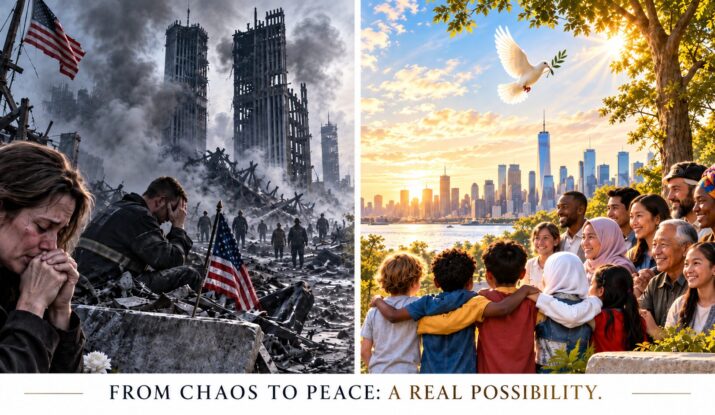
The Second Layer of the Tragedy Humanity Still Needs to Learn to See
There are dates that belong to history, and there are dates that continue to interrogate humanity. September 11 is one of them.
Every anniversary brings back the images, the testimonies, the tears, the names of the victims, and the almost indescribable scale of that morning. Remembering is necessary. Honoring the dead is a moral duty.
Yet perhaps we owe those who lost their lives an even greater obligation: to ask what we have truly learned.
Because if, after so many wars, attacks, massacres, and sacrificed generations, we continue to reproduce the same mechanisms of hatred, radicalization, and violence, then perhaps memory has been preserved, but the lesson remains incomplete.
1. THE SECOND LAYER
The news tells us: What happened?
Reflection must go further: Why did it happen? And, above all: What can we do to reduce the conditions that make similar tragedies possible?
This is the second layer, the one that so often disappears beneath the impact of the images.
It is not enough to show the destruction. We must understand the mechanisms that allow fanaticism to flourish, humiliation to harden into resentment, societies to lose perspective, and hatred to become an instrument of mobilization.
Memory without reflection risks becoming mere ritual. Humanity needs something more. It needs learning.
2. THE GEARS OF HATRED
Extremism does not arise in a vacuum.
It finds fertile ground wherever there is fear, exclusion, humiliation, intolerance, propaganda, a lack of prospects, and societies subjected to prolonged periods of violence and instability.
Added to this are political, strategic, and economic interests that, in certain contexts, may benefit from the perpetuation of conflict.
A perverse mechanism thus takes shape, sustaining alienation and preserving the status quo while keeping humanity trapped in patterns that delay the maturation of consciousness.
Hatred fuels conflict. Conflict produces new pain. Pain generates new resentment. And resentment feeds hatred once again.
Where do we break this cycle? Perhaps this is one of the most important questions of our time.
3. PEACE MUST OFFER MORE THAN HATRED
Extremist leaders thrive when they succeed in convincing populations that there is no alternative.
When prospects, opportunities, and meaningful economic participation are lacking, narratives built on resentment can gain ground.
Therefore, perhaps the most rational way to weaken extremism politically is not merely to confront its leaders. It is also to shrink the social terrain from which they recruit, persuade, and perpetuate themselves.
Imagine if even a fraction of the resources consumed by decades of war were redirected toward the economic transformation of regions scarred by conflict:
- Education.
- Infrastructure.
- Agriculture.
- Water.
- Technology.
- Energy.
- Employment.
- Production.
- Commerce.
- Entrepreneurship.
- Dignity.
Peace must, in concrete terms, become more attractive than war.
4. DEVELOPMENT AS AN INSTRUMENT OF DETERRENCE
Such investment, however, cannot simply consist of transferring money.
It must be carried out transparently, under measurable and effective oversight, with the participation of donor countries and institutions, international organizations, and trusted local representatives.
Benchmarks must be established. Results measured. Resources audited. And the beneficiary populations themselves must actively participate in the process.
Aid would then cease to be merely a financial transfer and become a genuine development partnership.
The more a community experiences tangible improvements in its daily life as a result of cooperation, stability, and productive activity, the less political space will remain for those who offer only violence, revenge, and the perpetuation of conflict.
This is not naïveté. It is strategy.
5. FORCE CAN CONTAIN, BUT IT CANNOT BUILD PEACE ALONE
No society can ignore genuine threats. States have a duty to protect their citizens and confront organizations that resort to violence.
However, there is a profound difference between containing an immediate threat and assuming that the permanent use of force can continuously eliminate the conditions that generate new threats.
Violence may, under certain circumstances, stop an act of aggression. But violence answered only with violence rarely builds lasting peace.
Security can contain a threat. Development can help prevent its reproduction. True victory begins when the extremist recruiter finds fewer young people willing to listen because those young people have begun to see a possible future beyond violence.
6. A GLOBAL COALITION FOR PROSPERITY
The economic reconstruction of regions historically scarred by conflict should not be the exclusive responsibility of a single power or bloc.
It could become a genuinely international endeavor, bringing together the countries of the region, the United States, China, the European Union, and other major economies around investment, infrastructure, production, technology, commerce, and development.
The objective should not be to divide spheres of influence, but to create shared interests in stability.
When countries that often compete with one another invest jointly in a region, they also begin to share in the economic benefits associated with peace.
War destroys wealth. Development creates wealth. And perhaps therein lies an opportunity still insufficiently explored: the progressive replacement of a geopolitics of confrontation with a geopolitics of shared prosperity.
7. DEVELOPING WITHOUT DOMINATING
Such an effort would be legitimate only if it avoided any appearance of tutelage, occupation, or external appropriation.
The peoples of the region must not be treated as passive beneficiaries of a foreign project. They must be partners and protagonists in their own development.
The goal would not be to create economic enclaves controlled by external powers, but to encourage international consortia, local business participation, professional training, modern agriculture, energy, commerce, infrastructure, and new markets.
The distinction is essential: not developing the region for its people, but developing it with them.
That difference separates cooperation from domination.
8. AN OPPORTUNITY FOR STRATEGIC LEADERSHIP
There are moments when international politics demands more than military capability. It demands strategic imagination.
A leader with a business background may understand particularly clearly that security can also be built through prosperity, investment, and economic interdependence.
In this context, President Donald Trump, given his background in the business world and his recurring emphasis on results and negotiation, could explore this possibility as the convener of a broad international development coalition.
Not as an American project for regional control, but as an international effort open to the participation of the countries directly involved, the United States, China, Europe, and other relevant economies.
The benefits could be twofold: economic and strategic. New markets, jobs, and investments could generate commercial returns. At the same time, populations with more tangible prospects for the future would likely leave less political space for movements that depend on resentment and violence for their survival.
This is not a question of partisan politics. It is a strategic question:
Would it be possible to invest in peace even a fraction of the intelligence and resources that the world has historically invested in war?
9. HUMANITY NEEDS A PRESSURE-RELEASE VALVE
We live in an age in which information circulates at extraordinary speed. But information does not necessarily produce consciousness.
We are exposed daily to wars, corpses, explosions, threats, and hate speech. Then comes another tragedy. Another image. Another scandal. Another outrage.
Emotion is kept in a state of permanent activation, while reflection often remains superficial. A consciousness confined to reaction rarely finds the space to mature.
Perhaps humanity needs a great intellectual, economic, and moral pressure-release valve: less stimulation of hostility and more understanding of causes; less glorification of confrontation and more investment in cooperation; less manufacturing of enemies and more creation of opportunity.
10. A CALL TO THE PRESS THAT SHAPES PUBLIC OPINION
Here, too, lies an extraordinary responsibility for the world’s major media outlets.
It is legitimate for the press to cover dramatic events, record history, serve the public interest, and respond to the demands of the news cycle. Yet major media organizations possess the capacity to offer something even more important: depth.
Major tragedies should not merely be shown. They should provoke questions.
What were their causes?
What mechanisms produced them?
What interests perpetuate those mechanisms?
What alternatives could reduce their recurrence?
The media possesses an enormous capacity to shape the agenda of collective reflection. Alongside reporting, images, and testimony, there is both room and necessity for philosophical, ethical, and rational inquiry into the forces that generate conflict.
Bringing these questions into the light of global public consciousness does not mean abandoning journalism. It means expanding journalism’s contribution to humanity.
11. THINKING WITHOUT CHAINS
There is yet another condition necessary for such reflection to be possible: intellectual freedom.
Political, partisan, or ideological alignment, when it hardens into automatic loyalty, compromises freedom of conscience. The citizen ceases to examine ideas on their merits and begins to judge them by their origin.
Reason demands the exact opposite: intellectual autonomy, a willingness to reassess one’s positions, and the freedom to embrace one proposal while rejecting another, regardless of who presents it.
Rational people may disagree. Yet they must remain capable of dialogue, of confronting evidence, and of correcting their own convictions.
Reason does not demand unanimity.
It demands intellectual honesty.
12. THE FINEST TRIBUTE
Perhaps the deepest tribute to the victims of September 11 is not merely to remember how they died. Perhaps it is to ask what we, the living, are doing to reduce the possibility that other human beings might meet a similar fate.
For centuries, humanity has refined its capacity to destroy to an extraordinary degree. Perhaps the time has come to apply comparable intelligence to the art of prevention.
Humanity remembers the explosions. It must also learn to dismantle the machinery that manufactures hatred.
It is not enough to ask who pulled the trigger.
We must also ask:
What keeps producing people willing to pull it?
This is perhaps one of the most important responsibilities history has left us: not merely to survive tragedies, but to learn from them.
Memory honors the dead. Reflection can help save the living.
_____________________
Analytical Reader’s Review
By Arthur Pendelton
The Awakening of Consciousness: A Critical Reading of the Essay on September 11
Twenty-five years after the fateful events of September 11, 2001, humanity remains confronted by a moral and strategic dilemma that transcends the annual solemnity of mourning. It is precisely within this critical space that the profound reflection advanced by the essay “September 11: When Memory Is Not Enough”takes root.
The central premise of the work exposes an uncomfortable truth: if, after decades of conflict and sacrificed generations, we continue to reproduce the same mechanisms of hatred and polarization, collective memory may have survived, but the historical lesson remains incomplete.
The text deliberately distances itself from impassioned rhetoric and partisan reductionism to propose what its author calls the second layer of the tragedy—the urgent transition from mere remembrance to a rigorous examination of the structural conditions that feed extremism.
The Gears of Hatred and the Geopolitics of Prosperity
The essay’s analytical strength lies in its methodical deconstruction of the machinery that sustains global violence. Extremism does not arise in a vacuum; it feeds on exclusion, instability, limited prospects, humiliation, and resentment.
In response, the text introduces a thesis of remarkable strategic imagination: peace must, in concrete terms, become more attractive than war.
Rather than relying exclusively on military supremacy—which may contain immediate threats without eradicating their underlying causes—the essay advocates the progressive replacement of a geopolitics of confrontation with a geopolitics of shared prosperity.
Its proposal for an international coalition devoted to the socioeconomic and technological development of vulnerable regions, grounded in cooperation and shared responsibility rather than tutelage or domination, offers a rational and potentially viable alternative to endless cycles of retaliation.
A Call to the Press and to Intellectual Autonomy
Another of the essay’s strengths is its courageous appeal to major media institutions and to contemporary public thought. By observing that instantaneous information and the permanent activation of emotion do not necessarily produce consciousness, the text challenges journalism to move beyond dramatic coverage and to assume a deeper investigative, philosophical, and ethical role in examining the forces that generate conflict.
Complementing this argument is an uncompromising defense of intellectual autonomy: the insistence that ideas be examined on their merits rather than judged by their political or ideological origin, rejecting blind allegiance in favor of reasoned conviction.
Concluding Remarks
This is a work of rare analytical sobriety and universal humanism. By combining diagnostic clarity with the courage to propose practical alternatives—such as redirecting intelligence, resources, and investment toward prevention and development—the essay fulfills one of the highest purposes of contemporary intellectual reflection.
Beyond remembering the past, the work establishes an imperative for the future:
Memory honors the dead; reflection can help save the living.
It is compelling reading for global leaders, academics, journalists, and citizens committed to the maturation of civilization.