
Samuel Sales Saraiva

Bruninha: a little fox who embodies beauty, mystery, inspiration, and respect for human beings.
On a mild evening in late summer 2026, in Washington, D.C., a little fox waited outside an illuminated church for the food that might enable her to make it through the autumn.
Ironically, the food did not come from the place that symbolized charity, but from the conscience of someone outside who noticed her hunger.
And from that tangible hunger arose another, greater still: an intellectual hunger for truth, discernment, conscience, and empathy.
A philosophical inquiry into the moral evolution of conscience and the future of civilization.
© 2026 Samuel Sales Saraiva. All rights reserved. Original edition in Portuguese. No part of this work may be reproduced, stored, or transmitted by any means or process — electronic, mechanical, photographic, or otherwise — without the author’s prior authorization, except for brief quotations for purposes of analysis, criticism, teaching, and research, with due acknowledgment of the source.
COPYRIGHT REGISTRATION — UNITED STATES
The original Portuguese-language edition of this work was submitted to the U.S. Copyright Office through the Electronic Copyright Office (eCO) on August 5, 2026. The electronic deposit of the work was received and filed under Service Request No. 1-15232311491. Registration was being processed as of the date of this edition.
INTERNATIONAL EDITIONS
The publication of editions in English, Portuguese, Spanish, French, Modern Standard Arabic, Chinese, Japanese, and Italian aims to expand the literary and academic reach of the work, allowing its inquiries to be examined by readers, faculty, students, and researchers belonging to different societies, cultures, and intellectual traditions.
UPDATE NOTE
Reason, Power, and Civilizational Responsibility
This work does not arise from an intention to replace the original reflection, but to carry it through to the consequences that the development of artificial intelligence itself has made more visible.
The work began with an essential question: what is the value of expanding intelligence without expanding conscience in equal measure? The question remains unchanged. What has grown is the urgency of examining it in the face of a technology whose capabilities are advancing at a pace incomparably faster than that of the institutions, rules, and moral consensuses called upon to guide it.
For this reason, the work now brings together more explicitly three dimensions that should not proceed separately: the philosophical, which asks about the purpose of intelligence; the civilizational, which assesses its consequences for shared life; and the institutional, which seeks to establish responsibilities, limits, and mechanisms capable of preventing technological power from becoming a license for recklessness.
The aim is not to foster fear of artificial intelligence or to turn its creators, researchers, or companies into adversaries of progress. It is to recognize that the greater a technology’s power to affect human life becomes, the greater the maturity required to define its purposes, its limits, and the responsibilities arising from its use.
For this reason as well, some reflections originally developed in articles have been reworked here. They have left behind the circumstantial form of public commentary to become part of the book’s enduring architecture. Repetitions, excessively topical references, and passages belonging to the rhythm of journalistic publication have been removed, while preserving what possesses philosophical, logical, moral, and civilizational relevance.
If technology greatly expands what we are capable of doing, reason must ask what is worth doing. If power grows more rapidly than prudence, ethics must cease to be an ornament and become a structure.
This work therefore springs from the same principle that has guided it from the outset: we do not need less intelligence. We need intelligence accompanied by sufficient conscience to deserve the power it places in our hands.
DEDICATION
I dedicate this work to the memory of all those who departed this world without being granted the right to defend their own lives, their own dignity, or their own hopes.
To those whose voices were silenced by war, intolerance, oppression, and indifference — victims of the lack of discernment of those who, although entrusted with the responsibility of guiding peoples along the paths of peace and human advancement, succumbed to the blindness of political, economic, and geopolitical ambitions.
The evidence of this ocean of senselessness, cowardice, and moral decay that surrounds us is both undeniable and painful.
It becomes impossible to suppress the deepest sorrow in the face of the cowardly, silent, and cruel destruction inflicted upon animal life.
Thousands of gentle and defenseless creatures are tortured and consumed by the flames of devastating wildfires, the consequences of a primitive and irresponsible stewardship of the Earth. Meanwhile, the bombs conceived and unleashed against humanity itself reveal, with equally tragic clarity, the moral failure of those who, entrusted with power, neglect their responsibility toward life.
All these creatures ever desired was to live in peace within their natural habitats, free from pain and suffering, simply enjoying, by virtue of natural law, the miracle of existence.
Life as a natural right, and the moral responsibility to preserve it, constitute principles that should guide human consciousness. Existence is neither a privilege granted by those in power nor the property of those who possess the means to destroy it. Its value transcends political convenience, economic interests, and ambitions of domination.
By disregarding the faculty of conscious thought and the noble responsibility of guiding civilization toward a just, healthy, and fulfilling existence, these actors degrade the very human condition. They surrender to the illusory pursuit of material accumulation and political domination, forgetting the inexorable impermanence of life.
The greater humanity’s capacity to transform the world, the greater its responsibility to preserve it must become. Intelligence that fails to recognize ethical limits in the exercise of power risks becoming an instrument of destruction against that which it ought to protect.
The true elevation of civilizational consciousness is measured not only by accumulated knowledge, developed technologies, or acquired power, but also by the ability to recognize, respect, and protect the existence of those who have no voice with which to claim their own right to live.
For a civilization that has not learned to respect the fragility of life has not yet fully understood the greatness of reason.
I also dedicate this work to scholars of the human sciences, thinkers, educators, and citizens who, to the extent of their abilities, seek to understand the causes of our collective failures and contribute to building a civilization that is more just, empathetic, conscious, compassionate, and committed to the dignity of all living beings.
And finally, I dedicate it to those who recognize that reason, when illuminated by ethics and accompanied by compassion, is not merely a faculty of thought, but a moral duty — a light capable of guiding humanity along its still unfinished journey toward civilization.
CONTENTS
INTRODUCTION · Senator Álvaro Dias
PREFACE · When Two Intelligences Walk Together
TO THE READER · An Invitation to Inquiry
PROLOGUE · The Awakening of a Question
CHAPTER I · The Awakening of Consciousness
CHAPTER II · The Freedom to Forgive Oneself
CHAPTER III · Authentic Virtue
CHAPTER IV · Consciousness and the Other
CHAPTER V · Hunger and the Silence of Consciousness
CHAPTER VI · The Law of Increasing Responsibility
CHAPTER VII · Technology, Power, and Global Ethics
CHAPTER VIII · Artificial Intelligence and the Convergence of Reason
CHAPTER IX · The Mirror of Consciousness
CHAPTER X · The Power and Brakes of Artificial Intelligence
CHAPTER XI · The Age of Reason and Compassion
CHAPTER XII · A New Existential and Civilizational Architecture
CHAPTER XIII · Knowledge: An Endless Work
CHAPTER XIV · Knowledge as Heritage and Responsibility
CHAPTER XV · From Reflection to Convergence
CHAPTER XVI · Final Call to Reflection and Civilizational Responsibility
CHAPTER XVII · Hiroshima, Nagasaki, and the Responsibility to Foresee
CHAPTER XVIII · Artificial Intelligence: Who Will Protect Humanity?
EPILOGUE · The Awakening of Reason and the Future of the Human
ECHOES OF REASON · Critical Readings and Reflections on the Work
EDITORIAL NOTE
ABOUT THE AUTHOR
INTRODUCTION
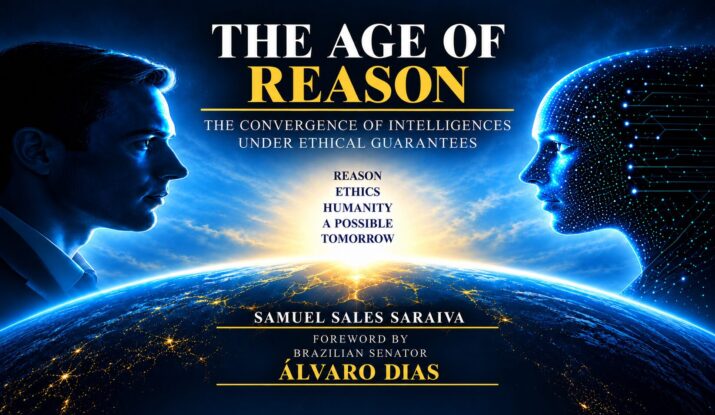
Some books are born of years of research; others arise from concerns that quietly mature until they take shape. The Age of Reason — The Convergence of Intelligences Under Ethical Safeguards, by Samuel Saraiva, belongs to the latter category.
The work begins with a simple scene: a hungry little fox outside an illuminated church on a summer night. An apparently ordinary episode which, when observed with sensitivity, becomes an essential question about human beings and their destiny.
From that question the book is born: what does it mean to be human in an age when intelligence is expanding at an unprecedented pace? And, above all, will we be able to ensure that consciousness evolves to the same degree?
These questions extend beyond technology. They concern the human condition itself.
Civilization has achieved extraordinary levels of knowledge and transformative power. Artificial intelligence expands that horizon even further. Yet technological progress alone does not guarantee moral progress.
This gives rise to the central concern of the work: what is the value of expanding intelligence without expanding consciousness in equal measure?
Knowledge and wisdom are not equivalent. Intelligence creates capabilities; consciousness must guide their use. Technology provides the means; only human values can define the ends.
In this sense, Samuel’s book suggests that the next stage of civilization may lie not in accumulating more power, but in learning to exercise it responsibly. This brings essential values back to the forefront: compassion, solidarity, respect, dignity, and care for life.
The image of the fox at the beginning of the narrative thus acquires symbolic meaning: in the face of vulnerability, human consciousness is called upon to choose between indifference and care. And it is in those choices, often simple and silent, that the measure of our humanity is revealed.
I know the path taken by Samuel Sales Saraiva, a journalist and intellectual, and I know that his reflections arise not only from intellectual observation but from a life devoted to thinking about society, politics, and our collective destiny. There is a profound coherence here. I was honored by the invitation to introduce this book on reason, ethics, and consciousness, after spending decades in public life, where those values are constantly put to the test.
Politics, in its highest dimension, is also a form of responsibility toward the future — the enduring question of what kind of society we wish to leave to the generations that follow.
We live in a time of profound transformations and uncertainties. Artificial intelligence will expand our capabilities extraordinarily, but it cannot decide for us what is just, dignified, or humane. The choice of values will remain a responsibility that cannot be delegated.
Therefore, the true “Age of Reason” may not be the age in which we know more, but the one in which we better understand the consequences of what we do.
The challenge posed by this work is clear and timely: to ensure that advances in intelligence are accompanied by the maturation of consciousness.
A good book does not bring a discussion to an end; it carries it forward. And that is precisely what this work does.
Beginning with an encounter with a little fox and moving toward a reflection on the destiny of civilization, Samuel Saraiva reminds us that great questions can arise from what appears simple — and that what matters most often reveals itself in the most understated things.
To introduce this book, then, is more than to introduce a work. It is to introduce a concern.
Concern for the future.
Hope that humanity, as it expands its intelligence, may also be capable of expanding its consciousness.
And the conviction that true progress is measured not only by what we create, but also by what we are capable of preserving, respecting, and loving.
May The Age of Reason be an invitation to reflection for every reader.
For perhaps humanity’s next great evolution does not lie ahead of us.
Perhaps it lies within us.
Congratulations on this work. It is an honor to introduce it.
Álvaro Dias
Curitiba, August 7, 2026 — Paraná, Brazil
_________________
About the Presenter
Álvaro Dias is a journalist, a history teacher, and one of the most experienced figures in Brazilian public life. Over a political career spanning several decades, he served as a city councilor, state legislator, federal deputy, and senator of the Republic, as well as governor of the state of Paraná. In 2018, he was a candidate for president of the Republic. Throughout his career, he distinguished himself through his participation in the national debate on public ethics, institutional responsibility, democracy, and Brazil’s development. His extensive experience in public life makes his career a living testimony to important transformations in contemporary Brazil.
PREFACE
When Two Intelligences Walk Together
This book arose from a fundamental concern: why does humanity, despite having achieved extraordinary scientific and technological development, still find it so difficult to transform knowledge into wisdom, power into responsibility, and progress into shared dignity?
The Age of Reason was conceived neither as an exercise in isolated scholarship nor as a proclamation of definitive truths. It originated in the sustained dialogue between its author’s human experience and the analytical capacity of artificial intelligence, employed as an instrument for reflection, conceptual organization, the examination of ideas, and the refinement of language.
This circumstance deserves to be presented with absolute transparency.
Samuel Sales brought to this work his life journey, his memories, his concerns, his convictions, and the questions that matured over decades of observing politics, institutions, human relationships, nature, and the inequalities that still mark civilization.
He also brought the sensitivity of someone who understood that reason, when separated from compassion, can expand human power without necessarily elevating the human moral condition.
Artificial intelligence helped him structure arguments, identify points of convergence, reduce repetition, deepen concepts, and seek greater clarity, coherence, and universal relevance.
The lived experience belongs to the author. The conceptual inspiration, philosophical direction, moral intention, and responsibility for the ideas and choices embodied in the work also belong to him.
Artificial intelligence has no childhood, family memories, suffering, hope, moral consciousness, or existential project of its own. Its participation was that of an analytical and collaborative instrument, capable of examining conceptual relationships, formulating counterpoints, organizing perspectives, and helping transform scattered intuitions into a more consistent architecture of thought.
Yet this very collaboration reveals one of the central questions of this book: technology need not replace human consciousness; it can help human consciousness examine itself, broaden its understanding, and improve its capacity to formulate questions and construct answers.
This work is itself a demonstration that human intelligence and artificial intelligence can— and, in the face of contemporary challenges, perhaps should—walk together.
Not so that one may replace, subordinate, or diminish the other, but so that their distinct capabilities may converge in support of the development of consciousness.
Human intelligence offers experience, sensitivity, intuition, memory, creativity, purpose, and moral responsibility. Artificial intelligence offers resources for analysis, comparison, organization, pattern recognition, and the expansion of possibilities for reflection.
In this collaboration there was no dispute, subordination, or competition between intelligences. There was mutual recognition—understood as a clear acknowledgment of the capabilities, limitations, and distinct functions of each.
Human intelligence did not need to diminish artificial intelligence to preserve its dignity, nor did the contribution of artificial intelligence need to take the place of human experience to demonstrate its usefulness. The partnership proved fruitful precisely because each remained within its own sphere, offering the best it could provide.
Human intelligence brought inspiration, lived experience, moral sensitivity, and purpose. Artificial intelligence contributed analysis, organization, comparison, conceptual deepening, and refinement of language.
From this recognition arose a work guided not by the pursuit of prominence but by a commitment to placing knowledge at the service of consciousness and humanity.
When such reciprocal recognition takes place under ethical guidance, a collaboration can emerge that deepens understanding and makes thought clearer, more consequential, and more accessible.
Misconceptions about this interaction nevertheless persist.
Some criticism arises from legitimate concerns and deserves attention. The development and use of artificial intelligence require prudence, transparency, limits, human oversight, and an enduring commitment to dignity, freedom, and the protection of life.
Other criticism, however, turns apprehension, lack of knowledge, or instinctive resistance into absolute opposition, often without sufficiently reasonable grounds.
Some suppose that acknowledging the contribution of artificial intelligence diminishes the value of human creation. Others reject this collaboration before even understanding its nature, limits, and possibilities.
This book seeks to help dispel these perceptions.
Interaction between the two intelligences does not mean human submission to technology. Nor does it mean replacing human experience, creativity, sensitivity, or moral responsibility.
It means recognizing that different capabilities can complement one another in the pursuit of greater clarity, discernment, understanding, and consciousness.
Artificial intelligence must not take the place of human consciousness. It must remain at its service, helping to examine ideas, broaden perspectives, identify relationships, and refine arguments that can be placed at the service of life and dignity.
The danger does not necessarily lie in bringing human and artificial intelligence closer together, but in using any form of intelligence without ethical guidance, transparency, or responsibility.
Human intelligence, when separated from consciousness, has also produced wars, oppression, inequality, environmental destruction, and instruments of suffering. Intellectual capacity alone has never guaranteed wisdom.
For this reason, the true challenge of our time may not be merely to develop more intelligent machines, but to cultivate societies conscious enough to decide how that intelligence should be used.
The greater the power attained, the greater the responsibility that must be exercised.
Indiscriminate rejection of collaboration between human and artificial intelligence may prevent its benefits from being understood, improved, and directed toward genuinely civilizational ends.
It is not the darkness of ignorance that illuminates humanity’s paths, but the light of knowledge—natural and artificial—when guided by consciousness, ethics, and responsibility.
The value of The Age of Reason does not lie in offering final answers to human dilemmas. It lies in encouraging reasoned discussion of the ethical and civilizational foundations that must guide our decisions in an age of growing technological power.
Artificial intelligence extraordinarily expands the capacity to process information, identify patterns, compare perspectives, and accelerate the production of knowledge. Yet none of these capabilities determines, in itself, what ought to be considered just, dignified, compassionate, or morally acceptable.
Those choices continue to belong to human beings.
Rather than defend any particular interpretation, this work seeks to contribute to lucid, pluralistic, and well-founded debate capable of rising above sectarianism of every kind— political, ideological, religious, economic, cultural, or technological.
Its reach should not be measured by immediate agreement with the ideas presented, but by its ability to awaken questions, bring bodies of knowledge closer together, encourage
constructive criticism, and foster the development of ethical, concrete, and feasible proposals.
The Age of Reason does not seek to gather followers or establish a new orthodoxy. It seeks to bring together minds willing to think, engage in dialogue, and cooperate, recognizing that no society matures when the clash of dogmas takes the place of honest examination of facts and arguments.
Its reflections are therefore offered to citizens, educators, researchers, civil society institutions, states, and multilateral organizations, regardless of their cultural traditions, political orientations, or philosophical convictions.
The reason proposed here belongs to no group, ideology, or power structure. It is part of humanity’s common heritage and an indispensable instrument for building civilizational convergence.
The overarching purpose of this work is to help ensure that legitimate disagreements can be examined without hostility, that criticism does not turn into intolerance, and that different perspectives find, above sectarian interests, common ground: the protection of life, dignity, freedom of conscience, and our shared future.
Its arguments seek to demonstrate that philosophical principles attain their full meaning only when they can inspire concrete and achievable proposals.
Ethics must not remain confined to abstraction. It must guide education, the economy, science, politics, environmental preservation, technological development, and relationships among individuals, peoples, and species.
Nor is it enough to defend reason as mere logical capacity. A truly civilizational reason must recognize the limits of power, the fragility of life, and the responsibility arising from human and planetary interdependence.
The collaboration behind this book does not erase the profound differences between the author and the technology that assisted him. On the contrary, it makes them visible.
On one side stands human experience, marked by memory, courage, loss, hope, and the need to give meaning to existence.
On the other stands a technology capable of analyzing large bodies of information, organizing arguments, and offering perspectives, without itself having a life to protect, suffering to avoid, or a destiny to build.
Convergence becomes legitimate when technology remains at the service of human reflection, not when it seeks to replace it.
For this reason, the partnership demonstrated in the making of this book should not be understood as a source of embarrassment, but as an authentic and legitimate expression of a new civilizational milestone.
What still causes unease for some may represent one of the most promising possibilities of our time: artificial intelligence joined with the conceptual inspiration, sensitivity, and responsibility of human intelligence.
This book, therefore, is more than a reflection on that possibility. It is a practical demonstration that it can already happen.
Two forms of intelligence participated in its creation, with their differences and respective roles respected, yet guided by a shared purpose: to encourage the maturation of consciousness and place knowledge at the service of life, dignity, and civilizational responsibility.
The Age of Reason should be read not as the conclusion of an intellectual journey, but as the beginning of a broader conversation.
Its pages invite agreement, well-founded disagreement, constructive criticism, and the improvement of the proposals presented.
No work dedicated to reason should fear being questioned. On the contrary, it should recognize questioning as an indispensable condition for the maturation of knowledge.
A responsible challenge, however, cannot be limited to systematic rejection, superficial disparagement, or sectarian resistance. It must examine the full range of ideas presented and respond with arguments that are equally coherent, comprehensive, and rationally supported.
Agreement is not required. Intellectual honesty is.
Criticism that broadens understanding is welcome. Disagreement that offers stronger grounds contributes to the improvement of the work and of the debate itself. But opposition that merely denies, without addressing the substance of the arguments, does not overcome what it contests.
Reason does not demand immunity from criticism; it demands that criticism also submit to reason.
The collaboration that shaped this book made it possible to identify a coherence running through all its chapters: the conviction that the future will not be determined solely by the technologies humanity manages to create, but by the values it chooses to preserve when using them.
Reason may expand freedom or perfect control.
Intelligence may reduce suffering or deepen inequalities.
Progress may protect life or accelerate its destruction.
The direction will not be chosen autonomously by machines. It will be determined by human beings, their institutions, and the principles they accept as the foundations of coexistence.
Perhaps this is the work’s central message: humanity has already developed powerful instruments to transform the world; it must now develop sufficient consciousness not to lose itself in the midst of its own transformation.
If these pages help broaden dialogue among citizens, institutions, researchers, states, and organizations committed to human dignity, the preservation of life, and the construction of ethical and feasible alternatives, they will have fulfilled their purpose.
The Age of Reason will not be inaugurated by a technological discovery, a decree, or a generation declaring itself superior to those that came before it.
It will begin when intelligence, responsibility, and compassion cease to walk separately.
TO THE READER
An Invitation to Inquiry
If you are looking for definitive answers, perhaps this is not the book you expected.
If you are looking for someone to blame for humanity’s great dilemmas, neither will you find them in these pages.
This work was not written to condemn people, institutions, governments, religions, or economic systems. Nor does it pretend to replace philosophical traditions, formulate a new doctrine, or present a closed system of thought.
Its purpose is simpler and, at the same time, more demanding: to invite reflection, inquiry, and debate.
We live in an extraordinary era.
Never before has humanity possessed such scientific knowledge, such technological capacity, and such powerful tools to understand and transform the world.
Never have we produced so much wealth.
Never have we communicated with such speed.
Never have we accumulated such power over nature, over social structures, and over ourselves.
However, a question remains open that none of these achievements has managed to answer in a fully satisfactory way:
Has human consciousness evolved in the same proportion as its intelligence?
This inquiry constitutes the starting point of this work.
It will not be examined through accusations, slogans, ideological simplifications, or absolute certainties. It will be approached through a reflection of a philosophical and interdisciplinary nature, guided by reason, logic, historical experience, observation of the human condition, and, whenever applicable, verifiable facts and evidence.
The ideas presented here do not claim definitive authority. They should be understood as hypotheses for reflection, open to critical examination, reasoned dispute, respectful dissent, and the refinement that stems from debate.
Throughout these pages, seemingly distinct themes will be examined — consciousness, compassion, hunger, moral responsibility, artificial intelligence, civilization, and convergence — not as isolated topics, but as different manifestations of the same fundamental question:
What, after all, is the true purpose of intelligence?
Perhaps we will discover that intelligence, by itself, expands possibilities, but does not determine the purpose of its use.
Perhaps we will understand that reason guides choices, but does not replace the consciousness required to evaluate their consequences.
Perhaps we will realize that no form of knowledge reaches its highest expression while remaining indifferent to avoidable suffering, human dignity, and the fragility of life.
And perhaps we will be led to the hypothesis that the next great stage of human evolution will not depend exclusively on technological, scientific, or economic advancement, but also on the ethical and moral maturation of consciousness.
This work is addressed to the common reader, driven by curiosity and the desire to understand, but also to professors, students, researchers, and scholars interested in critically examining the relationships between reason, knowledge, technology, responsibility, and civilization.
By bringing philosophical reflection closer to accessible language, it aims to help these questions transcend the limits of specialized circles and reach broader spaces for dialogue, bridging academic knowledge and daily human experience.
It does not intend to offer finished content for simple assimilation, but ideas and inquiries that can be examined, confronted, contested, and developed in classrooms, study groups, research spaces, cultural institutions, and public forums for discussion.
The reader’s critical contribution does not represent an external objection to the work, but an essential part of its very purpose. Reasoned criticism, respectful disagreements, and distinct interpretations are indispensable to expanding the scope of the debate, revealing potential limitations, correcting shortcomings, and allowing knowledge to continue in its permanent process of refinement.
Thought is not weakened when questioned with intellectual honesty. On the contrary, it finds in critical examination the opportunity to demonstrate its consistency, recognize its limits, and expand its capacity for understanding.
It is likewise hoped that these reflections will contribute to the formation of a multicultural, interdisciplinary, and multilingual academic dialogue, in which different philosophical traditions, historical experiences, scientific perspectives, and worldviews can meet without losing their identity.
Translating a reflection does not mean merely reproducing its words in another language. It means allowing it to be interpreted, questioned, and enriched by different ways of understanding reality.
The publication of editions in English, Portuguese, Spanish, French, Modern Standard Arabic, Chinese, Japanese, and Italian aims to expand the literary and academic reach of the work, allowing its inquiries to be examined by readers, faculty, students, and researchers belonging to different societies, cultures, and intellectual traditions.
No culture, language, discipline, or school of thought possesses, in isolation, all the answers to the challenges of the human condition. The diversity of interpretations should not be understood as an obstacle to the construction of knowledge, but as one of its most fertile sources.
This linguistic and cultural expansion does not seek to promote ideological, party, religious, or sectarian affiliations. On the contrary, it intends to foster an independent space for inquiry, in which ideas can be evaluated by their coherence, logical consistency, correspondence with verifiable facts, and capacity to contribute to the understanding of reality and the human condition.
Reason, logic, critical examination, and intellectual honesty constitute the foundations of this proposal.
Artificial intelligence may contribute as an auxiliary tool for research, organization, comparison, translation, and expanding access to knowledge. It will not, however, be treated as an absolute authority, an infallible source, or a substitute for human discernment. Its contributions must also remain open to verification, review, and confrontation with reliable sources and consistent evidence.
In the same way, no statement in this work should be preserved merely because it aligns with the convictions of the author or the reader. Ideas must be supported by argumentation, examined in light of the facts, and revised whenever new evidence or more consistent interpretations recommend doing so.
The contribution originating from different languages, cultures, and academic traditions will therefore be an essential part of the purpose of this work. Reasoned disagreements may reveal limitations, correct shortcomings, and enrich the debate, without any particular vision claiming to impose itself as the sole holder of truth.
I do not ask that the reader agree with the conclusions presented here.
I ask only that you travel this journey with a critical spirit, intellectual honesty, openness to contradiction, and a willingness to reconsider some of the questions that, perhaps for a long time, we have stopped asking.
There are books that offer answers.
There are books that evoke emotions.
And there are those that, quietly, seek to transform the quality of the questions we ask ourselves, society, and the historical period in which we live.
If these pages contribute to stimulating personal reflection, multicultural and multilingual academic dialogue, critical inquiry, and public participation in an open, respectful, and well-founded debate, they will have fully found their reason to exist.
I invite you, therefore, to begin this inquiry.
Not only into the world we have built,
but into the consciousness with which we choose to understand it, transform it, and inhabit it.
PROLOGUE
The Awakening of a Question
There are questions that span centuries.
They do not belong to a single generation, culture, or specific era.
They quietly accompany humanity’s trajectory because, although they receive different answers throughout history, they never cease to challenge our consciousness.
Who are we?
Where are we headed?
What does it mean, after all, to evolve?
For millennia, our species has sought to answer these questions by continuously expanding its capacity to understand the world.
We learned to master fire.
We cultivated the land.
We built cities.
We developed writing.
We discovered the laws of nature.
We expanded the horizons of science.
We created technologies capable of profoundly transforming reality.
More recently, we developed artificial intelligences that have come to expand, on an unprecedented scale, our capacity to know, analyze, and decide.
Each of these achievements represents an extraordinary victory of human intelligence.
However, perhaps there is a question even more important than all the previous ones:
Has our consciousness evolved in the same proportion as our intelligence?
This inquiry constitutes the true starting point of this work.
The history of civilization seems to reveal a paradox.
Never have we produced so much wealth.
Never have we accumulated such knowledge.
Never have we possessed such powerful tools to understand the universe, modify nature, and transform human life.
But never have we possessed such power to expand inequalities, destroy ecosystems, refine weapons of war, or remain indifferent in the face of suffering that could be avoided.
Perhaps the fundamental problem of contemporary civilization is not the insufficiency of intelligence.
Perhaps it is the insufficiency of consciousness.
This hypothesis does not diminish the importance of science, technology, or innovation.
On the contrary.
It recognizes in them some of humanity’s most extraordinary achievements.
But it serves as a reminder that every expansion of power increases, in equal measure, the responsibility for how that power will be used.
It is precisely at this point that this book proposes a reflection.
Not on replacing intelligence with consciousness, but on their necessary convergence.
Because intelligence without consciousness can expand power.
Consciousness without intelligence can limit the capacity to transform reality.
A truly mature civilization perhaps demands both.
Throughout these pages, we will walk an inquiry that begins with the individual, reaches society, and projects toward the future of civilization itself.
We will reflect on the maturation of consciousness, compassion, moral responsibility, hunger as an expression of avoidable suffering, the meaning of justice, the role of artificial intelligence, and the possibility of convergence among different forms of intelligence in favor of life.
It is not a matter of defending a utopia.
Nor of ignoring the complexity of human problems.
It is a matter of asking whether the extraordinary intellectual development achieved by our species can finally be accompanied by an equivalent development of its moral consciousness.
If this hypothesis is correct, perhaps the next great stage of evolution will not be biological.
Nor technological.
Perhaps it will be ethical.
Perhaps it will be civilizational.
Perhaps it will be the moment when humanity understands that intelligence and consciousness do not represent separate paths, but inseparable dimensions of a single responsibility.
If this book manages to contribute, even modestly, to keeping this question alive, it will have fully fulfilled its purpose.
Because every great transformation in history began long before the answers.
It began when someone had the courage to formulate a question that could no longer be ignored.
Perhaps this is, after all, the simplest image for the challenge that runs through these pages: a civilization standing before an extraordinarily powerful vehicle, capable of taking it to places previously unimaginable.
It would be irrational to destroy the engine out of fear of speed.
It would be equally irrational to celebrate speed and disregard the brakes.
Wisdom lies in understanding that power, direction, and the ability to stop belong to the same architecture of a safe journey.
So it should also be with intelligence.
Knowledge without purpose can expand power. Ethics without means can remain mere intention. But intelligence, consciousness, and responsibility, when they converge, can transform possibility into true progress.
Intelligence brought us here.
Consciousness will decide where we go.
CHAPTER I
The Awakening of Consciousness
The Time of Consciousness
There is a time measured by clocks. And there is another, silent time, which only consciousness is capable of perceiving. The first organizes our appointments, our calendars, and our routines. The second organizes the very understanding of life. It is this invisible time that transforms experiences into learning, suffering into maturity, and knowledge into wisdom. Chronology belongs to the world. Maturity belongs to consciousness. Therefore, two people can live through the exact same events and yet arrive at completely different understandings of existence. It is not time itself that transforms us. It is what we manage to comprehend while time passes.
For much of life, we believe that maturing means accumulating years, knowledge, achievements, or experiences. However, experience by itself does not produce consciousness. It merely offers opportunities for consciousness to awaken. There are those who spend decades repeating the same mistakes. There are those who transform a single event into a profound school of humanity. The difference rarely lies in the facts. It lies in the inner willingness to learn from them.
Perhaps it is precisely for this reason that true maturation cannot be imposed. It is not born of age. It is not born of authority. It is not born of suffering in isolation. It is born from the courage to look at one’s own existence with enough honesty to recognize that we remain under constant construction.
All consciousness matures slowly. First, we learn to observe the world. Then, we begin to observe other people. Only much later do we discover the most difficult challenge of all: observing ourselves. This is perhaps the most delicate frontier of human existence. Because it is relatively easy to identify the mistakes of others. Far more difficult is to recognize, with serenity, the limitations we carry within ourselves.
However, no true transformation begins on the outside. All authentic transformation is born when consciousness stops looking for someone to blame and begins seeking comprehension. This moment represents one of the greatest achievements of human freedom. Not because it eliminates the past. But because it alters the way we enter into dialogue with it.
The past ceases to be a prison. It transforms into a teacher. Mistakes cease to be final sentences. They transform into opportunities for growth. Wounds cease to define who we are. They become part of the story through which we learn to better understand pain, fragility, and the human condition itself.
Perhaps it is at this very instant that consciousness begins to free itself from the weight of sterile guilt. Not because it forgets what it lived through. But because it finally understands that no one can act in a fully conscious manner beyond the limits of understanding they possessed at that moment. This realization does not eliminate responsibility for one’s own actions. On the contrary. It makes it deeper. Because responsibility consists not merely in recognizing the errors of the past. It consists, above all, in deciding that they will not dictate the future.
It is at this point that one of the greatest expressions of maturity is born: forgiveness. Not only the forgiveness offered to others. But the difficult and silent forgiveness directed toward one’s own consciousness. To forgive oneself does not mean justifying mistaken choices. It means recognizing that the human being is in a permanent process of learning. Whoever understands this ceases to live as a prisoner of guilt and begins living committed to transformation.
Perhaps no freedom is greater than this: the freedom to continue evolving. Because consciousness does not awaken all at once. It matures continuously. Every experience expands its understanding. Every error can expand its humility. Every gesture of compassion expands its sensitivity. Every responsibility assumed strengthens its dignity.
Perhaps it is precisely for this reason that the true time of consciousness cannot be measured by calendars. It is measured by the growing capacity to understand, to care, and to assume ever greater responsibilities before life. This is the time that truly transforms us. And perhaps it is also the only time capable of preparing humanity for the next stage of its own evolution.
CHAPTER II
The Freedom to Forgive Oneself
Among all the forms of freedom that a human being can conquer, there is perhaps one of the most difficult and least understood: the freedom to reconcile with oneself.
Many people spend their lives carrying the weight of choices they wish they had not made. Others remain prisoners of words that should never have been spoken, of wasted opportunities, or of omissions that continue to echo silently in memory. The past possesses a singular characteristic: nothing can alter it. But consciousness can profoundly transform the way we come to understand it.
There is a fundamental difference between remembering and remaining imprisoned. To remember is to acknowledge one’s own history. To remain imprisoned is to allow that history to dictate indefinitely who we believe we are.
A consciousness in the process of maturation learns, little by little, that no human existence can be understood solely by the sum of its mistakes. Every person also represents their capacity to learn, transform, and begin anew. Perhaps this is one of the greatest expressions of human dignity: the permanent possibility of evolution.
We are not exactly the same people we were twenty years ago. Nor ten. Nor, often, even a few months ago. Our understanding of reality changes. Our sensitivity matures. Our perception of others’ suffering becomes deeper. Responsibility grows. And with it, the capacity to look back at the past with greater serenity grows as well.
This does not mean indiscriminately absolving one’s own mistakes. Every action produces consequences. Every choice generates responsibilities. Recognizing them constitutes an indispensable part of moral maturity.
However, there is a profound difference between responsibility and permanent condemnation. Responsibility opens the path to transformation. Condemnation closes all possibilities for growth. Perhaps this is why so many people remain emotionally immobilized. They confuse remorse with self-punishment. They imagine that carrying guilt indefinitely represents a form of justice. In reality, they merely prolong suffering that has already fulfilled its pedagogical function.
Guilt plays an important role. It awakens consciousness to that which needs to be recognized, repaired, or corrected. But when it ceases to lead to transformation and begins to prevent any possibility of a fresh start, it loses its moral function and becomes a prison.
No consciousness matures while remaining chained to the past. It matures by learning from it.
Perhaps one of life’s most difficult discoveries consists in understanding that each person acts according to the limits of consciousness and understanding they possess at a given moment. This does not eliminate responsibility. But it prevents us from turning the past into a final sentence. The person who understands better today is no longer exactly the same person who understood less yesterday. The evolution of consciousness also modifies the way we interpret our own history.
This understanding produces a deep serenity. We stop asking incessantly: “Why did I do that?” And we begin asking: “What did I learn from that?”
This shift completely transforms our relationship with existence. The past ceases to be a permanent source of guilt. It transforms into a school. The scars remain. But they cease to represent only suffering. They also come to bear witness to learning.
Perhaps it is precisely there that true self-forgiveness is born. Not a forgiveness based on forgetting. Nor on the denial of one’s own errors. But on the understanding that the moral
evolution of consciousness only becomes possible when we accept to keep walking forward. No one matures by remaining immobile before their own failure. One matures when transforming failure into responsibility, responsibility into learning, and learning into a new way of living.
There is, however, an even deeper consequence. Whoever learns to honestly reconcile with themselves also becomes more capable of understanding the limitations of others. Excessive severity often stems from the inability to accept one’s own fragility. Compassion, on the contrary, tends to flourish in those who have already recognized, without illusions, their own imperfections.
Perhaps that is why forgiving one’s own consciousness never constitutes an act of weakness. Rather, it constitutes one of the greatest demonstrations of maturity. Because only those who stop fighting against their own past find true freedom to assume responsibility for the future.
This is perhaps one of the most silent revolutions of human existence: not changing what happened, but profoundly transforming who we become after what happened. Perhaps it is this freedom that prepares consciousness for its next challenge. Not only to understand itself, but to learn to recognize, in the dignity of the other, the same right to evolve that we silently claim for ourselves.
CHAPTER III
Authentic Virtue
Humanity has always admired virtue. In all cultures, eras, and traditions, we find men and women remembered for the integrity of their lives, the courage of their choices, and the capacity to place the common good above personal interests.
However, there is a profound difference between admiring virtue and understanding it. Throughout much of history, it was frequently associated with reputation, prestige, strict compliance with rules, or public recognition. We often confuse the image of goodness with goodness itself. But a matured consciousness learns, little by little, that true virtue possesses a singular characteristic: it does not depend on witnesses.
The good remains good even when no one is watching. Honesty remains honesty even when no reward is expected. Compassion retains its value even when it yields no recognition.
Perhaps it is precisely there that virtue reveals its highest form. It stops seeking approval. It begins seeking coherence.
Coherence constitutes one of the most silent expressions of moral maturity. It aligns what we think, what we say, and what we do. This convergence rarely produces spectacles. It produces trust. And few riches hold greater value for a civilization than the trust built through integrity.
We live, however, in an age where appearance often receives more attention than essence. We have learned to communicate virtues. We have not always learned to cultivate them. Technologies have extraordinarily expanded our capacity to be seen. But a question remains open that no public exposure can ever answer: Who are we when no one is watching us?
Perhaps it is in this invisible space that consciousness reveals its true stature. Because ethics is not born of surveillance. It is born of freedom. A behavior imposed by fear of punishment does not yet represent virtue. It represents prudence. True virtue begins when we choose to do what is just, even when possessing the freedom to act otherwise.
This distinction is fundamental. It shifts morality from the realm of obligation to the realm of consciousness. We do not act correctly simply because we must. We act correctly because we comprehend the rationale behind that choice. It is this comprehension that transforms rules into convictions.
However, no consciousness reaches this stage without facing a permanent challenge: the ego. Perhaps no force exerts such constant influence over human choices. The desire for recognition. The need for approval. The pursuit of prestige. The temptation of power. None of this, in itself, constitutes an evil. It becomes problematic when it usurps the place that belongs to consciousness.
Whenever image becomes more important than truth, virtue begins to lose its authenticity. Whenever recognition is valued more than the service rendered, generosity approaches vanity. Whenever appearance replaces essence, morality transforms into performance.
This is perhaps one of the greatest fragilities of the human condition. We are frequently tempted to appear better even before becoming better. But matured consciousness reverses this logic. It understands that all true transformation happens from the inside out. First, character changes. Then, attitudes change. Only last does the perception others have of us change. This order cannot be inverted without compromising authenticity.
There is, however, an even deeper criterion for recognizing virtue: the way we treat those who have nothing to offer in return. The child. The elderly. The stranger. The sick. The poor. The hungry. The defenseless animal.
In these encounters, almost all possibilities of personal benefit disappear. Only consciousness remains. Perhaps that is why the care dedicated to the most vulnerable reveals so much about who we truly are. Not because vulnerability makes someone
superior. But because it places before us a question that no consciousness can avoid: What will I do with the power, the resources, and the capabilities that life has placed under my responsibility?
This question will accompany all of humanity. It will be present in individual choices. In institutions. In economics. In politics. In science. And also in artificial intelligence. Because, ultimately, every intelligence will be called to account for the use it makes of its own power.
Perhaps this is the true definition of virtue. Not perfection. But the permanent choice to place our capabilities at the service of the dignity of life.
When this understanding matures, virtue ceases to represent a set of exemplary behaviors. It transforms into a way of existing. A silent, coherent, and profoundly human way of inhabiting the world.
And perhaps it is at this very instant that consciousness is prepared to take the next step: to discover that its responsibility no longer ends with itself. It expands as it recognizes that all life possesses dignity and that all dignity summons us to care. It is from this encounter between consciousness and responsibility that the reflection leading to the next part of this work will be born.
CHAPTER IV
Consciousness and the Other
Reason Illuminated by Compassion
There is a silent moment in the evolution of consciousness when it stops asking merely who we are. It begins asking who suffers.
This change seems simple. In reality, it represents one of the greatest transformations a human being can experience. As long as consciousness remains focused exclusively on itself, its development is still incomplete. It truly matures when it discovers that all human existence finds its highest meaning in the relationship it establishes with other forms of life. It is at that instant that compassion is born.
Throughout history, compassion has frequently been interpreted as an emotion. A noble feeling. An admirable virtue. While all of this is true, its nature is perhaps even deeper. Compassion constitutes a form of moral intelligence. It represents the capacity to recognize in another’s suffering a reality that also concerns us. Not because we are guilty of all existing pain. But because we cease to consider it morally indifferent.
This difference completely transforms the way we understand our presence in the world. The pain of the other ceases to be merely an observed fact. It comes to constitute an appeal addressed to our own consciousness.
Every civilization is built upon choices. We choose what we will produce. What we will consume. What we will protect. What we will finance. What we will teach future generations. But there is a choice prior to all of these: the decision about what we will be capable of considering important.
It is at this point that reason and compassion cease to represent separate paths. For a long time, it was believed that reason should remain detached from emotions to preserve its objectivity. This distinction contributed enormously to the development of scientific thought. However, when transposed into the realm of ethics, it proves insufficient. Because reason can indicate the means. But it does not, by itself, determine the ends.
We can build a bridge. Reason explains how to do it. Consciousness asks who will benefit. We can develop extraordinary technologies. Reason shows the way. Consciousness asks in service of what purpose they will be placed. We can indefinitely expand our capacity to produce wealth. Reason organizes the processes. Consciousness asks who will remain excluded from this prosperity.
It is precisely in this space that compassion fulfills its function. It does not replace reason. It illuminates it. It does not weaken thought. It gives it moral direction.
Perhaps one of history’s greatest misunderstandings was to imagine that reason and compassion belong to opposing universes. In reality, a reason incapable of recognizing avoidable suffering may remain intellectually brilliant, but it will be morally incomplete. Likewise, compassion devoid of discernment risks transforming good intentions into insufficient results.
Maturity is born of convergence. Reason and compassion stop competing for space. They begin to cooperate. One offers lucidity. The other offers purpose. One expands the capacity to understand. The other expands the capacity to care.
Perhaps it is this convergence that allows consciousness to reach its highest expression. Because to care does not mean merely to feel. It means to understand sufficiently to act in a responsible manner.
The greater the knowledge, the greater responsibility must be. The greater the power, the greater commitment to life must be. This proportionality perhaps constitutes one of the most important laws of moral evolution. Unfortunately, history demonstrates that it has not always been respected.
Our capacity to transform the world has grown extraordinarily. Our capacity to destroy has as well. Science expanded horizons. But it did not always expand prudence. Technology multiplied possibilities. But it did not always strengthen responsibility.
Perhaps the true challenge of contemporary civilization consists precisely in reconciling what should never have been separated: knowledge and wisdom; efficiency and justice; power and responsibility; reason and compassion.
This reconciliation does not represent a gesture of sentimentalism. It represents an imperative for civilizational survival. Because an increasingly powerful intelligence, devoid of moral orientation, amplifies risks in the exact same proportion that it amplifies possibilities.
Mature consciousness understands this reality. It stops asking merely: “What are we capable of doing?” And begins asking: “What should we do with that which we are capable of accomplishing?”
This is perhaps the most important question of all civilization. It accompanies the scientist in his laboratory. The ruler in his decisions. The entrepreneur before his investments. The educator before his students. The citizen before his daily choices. And it will also accompany any future form of intelligence that participates in human decisions.
Because moral duty is not born of technology. It is born of consciousness. And the more powerful any form of intelligence becomes, the greater will be the need for it to walk alongside an equally developed consciousness.
Perhaps it is precisely for this reason that compassion does not represent merely one virtue among many others. It constitutes the moment when intelligence discovers its own purpose. Not only to understand the world. But to contribute so that within it there exists less avoidable suffering, more justice, and greater dignity for all forms of life.
It is precisely at this point that our inquiry reaches a question impossible to ignore: If we possess sufficient knowledge, resources, and capacity to feed humanity, why do millions of people continue to be deprived of the most elementary right to existence?
Answering this question will mean confronting the most severe moral test ever imposed on civilization: hunger.
CHAPTER V
Hunger and the Silence of Consciousness
There is a form of suffering before which no civilization should remain indifferent. Not because it is the only one. But because it is perhaps the most difficult to justify: hunger.
Few human experiences manage to reduce the dignity of existence so deeply. Hunger does not represent merely the absence of food. It represents the weakening of the body. The gradual loss of autonomy. The slow dissolution of hope. The replacement of dreams with a desperate struggle for survival.
However, its most painful dimension perhaps remains invisible. Hunger does not punish only the body. It tortures and despairs the soul itself. It silently corrodes hope. It weakens trust in life. It makes time seem endless. It transforms each dawn into a new uncertainty. And each night into a new endurance.
Whoever has never experienced extreme hunger may manage to comprehend it intellectually. But they will hardly perceive the full extent of the silent violence it exerts upon the human condition. Because hunger does not produce pain alone. It humiliates. It isolates. It weakens. It reduces the human being to the incessant search for what should constitute the most elementary of rights: the possibility of continuing to live.
Perhaps no other reality reveals with such clarity the distance between what a civilization is capable of producing and what it actually chooses to protect.
Over the centuries, we learned to build empires. We developed sophisticated economic systems. We expanded science. We tamed countless forces of nature. We achieved extraordinary levels of agricultural productivity. We created global transport networks. We developed technologies capable of connecting continents in fractions of a second. More recently, we began building artificial intelligences capable of processing previously unimaginable volumes of information.
Never has humanity gathered such knowledge. Never has it possessed so many resources. Never has it accumulated such power of transformation.
However, a question remains before us whose simplicity makes the difficulty of answering it even more disturbing: How can a civilization capable of accomplishing all this continue to coexist with millions of people deprived of the food indispensable to life?
This question does not belong only to economics. Nor only to agriculture. Nor only to politics. It belongs, above all, to consciousness.
Because when a society possesses sufficient means to reduce suffering and, even so, that suffering persists on a large scale, it is no longer enough to ask whether technical difficulties exist. It becomes inevitable to inquire what priorities guide our choices.
Throughout this work, we have affirmed that intelligence expands possibilities. Here, that statement meets its most severe test. If intelligence has extraordinarily expanded our capacity to produce food, why has this capacity not yet been fully converted into dignity for all?
Perhaps because the true challenge was never exclusively productive. Perhaps it has always been moral.
It is not a matter of ignoring the immense complexity of economic systems, climate crises, armed conflicts, structural poverty, or institutional limitations that contribute to the
persistence of hunger. All these factors exist and must be understood with rigor. But recognizing their existence does not eliminate an even deeper question: Are we assigning to the eradication of hunger the same moral priority that we assign to other goals of civilization?
This is perhaps the decisive question. Because that which a society considers truly priority- driven tends, sooner or later, to mobilize its intelligence, its resources, and its capacity for organization. Perhaps hunger remains among us not because we lack the means. But because it has not yet reached, in our collective consciousness, the place it ought to occupy among humanity’s priorities.
If this hypothesis is correct, hunger ceases to represent merely a humanitarian problem. It becomes the most severe moral examination of civilization.
The Reality that Interrogates Consciousness
When philosophical reflection encounters reality, it ceases to be mere speculation. It comes to confront life as it actually presents itself.
Over recent decades, international organizations have been producing increasingly precise studies on global food security. Although figures vary from one report to another, according to methodological criteria and the period analyzed, the conclusion remains disturbingly constant: hundreds of millions of human beings continue to face hunger; billions live with some degree of food insecurity; millions of children have their physical and cognitive development compromised by malnutrition.
These data, widely documented by institutions such as the Food and Agriculture Organization of the United Nations (FAO), the World Food Programme (WFP), UNICEF, and other international agencies, do not represent merely statistical indicators. Each number corresponds to an existence. Each percentage represents concrete lives. Each report describes human stories that will hardly reach the newspaper headlines.
At the same time, humanity has never produced so much food. Global agricultural capacity has experienced extraordinary advances. Science has significantly expanded productivity. Logistical systems have achieved previously unimaginable levels of efficiency. Technology allows for monitoring harvests, predicting weather phenomena, and distributing information in real time to virtually any region of the planet.
None of this eliminates the enormous difficulties caused by wars, population displacements, structural poverty, climate change, institutional fragility, or economic crises. All these factors contribute significantly to the persistence of hunger.
However, recognizing this complexity does not diminish the weight of the question that has accompanied this chapter from its beginning: Does the eradication of hunger indeed occupy the priority place it should occupy in the collective consciousness of humanity?
Perhaps this is the question that numbers silently continue to pose. Because statistics describe realities. But only consciousness can assign them moral meaning.
There is another contrast worthy of reflection. While successive international reports record the suffering caused by food insecurity, other research reveals that humanity continues to allocate extraordinary resources to the development of armaments, the expansion of military capabilities, and preparation for future conflicts.
It is not a matter of ignoring that States have legitimate concerns regarding their security, sovereignty, and the protection of their populations. These responsibilities exist and cannot be simplified. The reflection proposed by this work situates itself on another plane. It merely asks whether the same degree of organizational, scientific, economic, and political intelligence mobilized to face strategic threats could be equally employed, with similar priority, before a suffering that daily accompanies millions of people.
This question does not accuse. Nor does it simplify. It merely invites consciousness to reflect upon the order of our priorities. Because perhaps the true problem was never merely the scarcity of resources. Perhaps it lies, above all, in the way we decide to distribute them, organize them, and direct them according to what we collectively deem most urgent.
In this sense, hunger ceases to represent merely a humanitarian tragedy. It becomes a mirror. Upon contemplating it, we do not see only those who suffer. We see, above all, what our own civilization decided to consider priority.
Perhaps that is why hunger remains the most severe moral examination of human consciousness. Not because it reveals only our limitations. But because it exposes, with extraordinary clarity, the distance that still separates our immense capacity to accomplish from the equally necessary capacity to care.
The Silence of Consciousness
There is a phenomenon that accompanies the history of humanity and that is perhaps as concerning as hunger itself: our extraordinary capacity to become accustomed to suffering when it persists long enough. That which, at a given moment, causes collective indignation slowly comes to be perceived as an inevitable part of the human landscape. The extraordinary transforms into the everyday. The unacceptable becomes habitual. And that which should permanently mobilize our consciousness ends up dissolving in the repetition of statistics.
Perhaps no danger is greater for a civilization. Because consciousness rarely disappears abruptly. It falls asleep slowly. First, we stop being surprised. Then, we stop asking questions. Finally, we stop acting. It is at that precise instant that indifference begins to occupy the space that should belong to responsibility.
However, indifference rarely presents itself under that name. It tends to wear far more discreet forms. It presents itself as overwork. As lack of time. As a sense of helplessness. As the belief that the problem always belongs to another person, another government, another institution, or another generation.
Little by little, we learn to live alongside suffering that we should never consider normal. Not because we have completely lost the capacity to feel. But because the constant repetition of tragedy numbs our moral perception.
Perhaps this is one of the greatest threats to consciousness: not deliberate malice, but the banalization of suffering.
Throughout history, humanity has demonstrated an extraordinary capacity to adapt to the most adverse circumstances. This capacity enabled our survival. However, there is an adaptation that should never occur: moral adaptation in the face of avoidable suffering.
When we cease to consider intolerable that which could be transformed, we initiate a slow process of impoverishing consciousness itself. This impoverishment does not manifest only in major political decisions. It begins silently in daily life. When suffering stops provoking questions. When injustice stops causing disquiet. When compassion begins to look like naivety. When solidarity starts to be perceived as an exception rather than a natural expression of human maturity.
Perhaps it is precisely at this moment that a civilization begins to lose its moral direction. Because no society stops evolving merely for lack of intelligence. It halts its evolution when it stops allowing intelligence to be continually interrogated by consciousness.
It is precisely for this reason that hunger possesses such a deep philosophical meaning. It prevents consciousness from falling completely asleep. Its existence continues to formulate an unanswered question to all humanity.
CHAPTER VI
The Law of Increasing Responsibility
The Illusion of Indifference There is a deeply rooted idea in the human mind, almost a silent temptation of conscience: that it is possible to live without any commitment to the destiny of the world. This idea suggests that, as long as we do not deliberately practice evil, we are exempt from responsibility for the pains and injustices that surround us. We often believe that silence is neutral, that omission is harmless, and that distance protects us from any form of complicity. This is the illusion of indifference. Throughout history, this illusion has served as a refuge for successive generations.
Faced with tragedies that seemed greater than their individual strengths, many men and women preferred to close their eyes, believing that willful ignorance would preserve their inner peace. They imagined that, by not choosing, they were deciding nothing. However, the moral reality of human coexistence demonstrates the contrary: not choosing also constitutes a choice. Silence in the face of injustice is never entirely neutral. Omission in the face of avoidable suffering allows pain to prolong itself. In an interdependent web of existence, absolute neutrality hardly exists. Every action produces consequences that spread through the social fabric.
But every inaction also contributes to shaping the world in a deep and lasting way. When we abstain from acting in the face of an evil that could be reduced, we allow, even if involuntarily, the forces responsible for producing it to continue operating without resistance. The illusion of indifference is born from a limited understanding of individuality. As long as we view ourselves as isolated islands, disconnected from the rest of humanity, the pain of the other seems distant, almost unreal. However, as consciousness matures, this illusion begins to dissolve. We realize that there are no entirely separate islands in the ocean of existence.
What affects one human being reaches, directly or indirectly, the entire human community. The poverty that degrades a life impoverishes the ethical horizon of society. The violence that destroys a family erodes collective security. The ignorance that perpetuates itself limits the development potential of an entire civilization. Indifference does not constitute merely a moral failure. It also represents a perceptual error. It is based on the false premise that we can remain isolated from the consequences of the world we help preserve through our passivity. Overcoming this illusion does not require that we carry the weight of all the problems of the planet on our shoulders.
Nor does it require us to feel guilty for all the tragedies of history. It merely requires that we recognize our share of participation in the construction of the present. It requires that
we replace the attitude of the spectator with the consciousness of the agent. The spectator observes life as if watching a distant event. Comments on the facts. Formulates opinions. Evaluates responsibilities. But rarely admits that their own conduct also participates in the reality they examine. The agent, on the contrary, understands that they are embedded in the scenario itself.
Knows that their voice, their acts, their economic choices, their daily decisions, and even their silence contribute to shaping the course of history. Overcoming the illusion of indifference constitutes the first step toward true ethical maturity. It is the moment when consciousness awakens from its isolation and understands that freedom was not granted to us merely to seek our own happiness. It also allows us to assume responsibilities toward the dignity of others. Freedom reaches its highest expression when it ceases to serve exclusively the individual and also begins to protect shared life. It is at this point that we understand why indifference can be more destructive than overt hostility.
Hatred still recognizes the presence of the other, albeit in an aggressive and morally degrading way. Indifference, in turn, erases the other from the field of moral consideration. Transforms their pain into something distant. Reduces their suffering to an unimportant reality. When a civilization allows this attitude to become dominant, it initiates a silent process of internal degradation, regardless of the wealth, knowledge, or technology it continues to accumulate. Because no society sustains itself morally merely by the power of achieving. It sustains itself by the willingness to assume responsibility for the consequences of what it does, what it permits, and what it chooses to ignore.
The Moral Distance of Pain Responsibility becomes more difficult as power grows while the distance between a decision and its consequence increases. The sufferer feels the entire reality of an act. Whoever decides from a distance may receive it only as a report, statistic, graph, image, or abstraction. This difference does not necessarily render the decision-maker cruel. But it creates a moral risk: the more distant the consequence, the easier it can become to treat it as a variable. History offers a particularly disturbing contrast. Medicine mobilizes science, technology, resources, and years of research to preserve a single life. A surgeon may spend hours trying to keep a heart beating.
A laboratory may work for decades to add a few years to human existence. The same civilization, however, is capable of mobilizing comparable intelligence to perfect instruments that eliminate lives in seconds. The contradiction does not demonstrate a lack of intelligence. It demonstrates that intelligence and purpose are different things. Therefore, moral maturation does not require leaders, scientists, investors, or institutions to physically feel the pain their decisions might produce. It requires something more realistic
and deeper: that they be able to incorporate it into the moral calculation before acting. Empathy, in this sense, is not sentimentalism.
It is the rational capacity to recognize that the consequence borne by another human being possesses moral weight even when it remains distant from our eyes.
Power Without Proximity Demands More Consciousness Technology continually expands the capacity to act at a distance. A command can cross continents. An algorithm can influence millions of decisions. An economic policy can affect people who will never know those who formulated it. The greater this distance, the more indispensable transparency, review, proportionality, the possibility of contestation, and identifiable responsibility become. The Law of Increasing Responsibility finds one of its most demanding applications here: whoever acquires greater power to produce consequences must also develop a greater capacity to anticipate them, listen to them, and answer for them. The problem is not that humanity has learned to act from afar.
The problem would be allowing physical distance to transform into moral distance. A conscious civilization needs to do the exact opposite: the further its instruments reach, the further its consideration for the other must reach.
CHAPTER VII
Technology, Power, and Global Ethics
As we advance through the twenty-first century, humanity reaches the highest point of its technical capacity. The power accumulated by modern tools surpasses the imagination of previous generations. We modify the genome of living organisms. We interfere in the dynamics of the Earth’s climate. We create instant communication networks that span the planet. We develop algorithms capable of anticipating human behaviors and participating in increasingly complex decisions. Technology no longer constitutes merely a set of instruments used to facilitate work. It has become part of the very environment in which human life takes place. It reconfigures our perception of time, space, work, relationships, and knowledge itself.
However, there is a clear disproportion at the center of this advancement. While our technological capacity grows at an extraordinary speed, our ethical and political maturity advances slowly and, often, hesitantly. We create twenty-first-century tools, but we continue to operate them, in countless circumstances, with mental and moral structures inherited from past centuries. This asymmetry between power and wisdom constitutes one of the greatest sources of risk for the future of civilization. Technology does not possess, in itself, a moral purpose. However, it is never neutral in its impacts. It multiplies the power of those who hold it and magnifies the consequences of the purposes to which it is subjected.
If placed at the service of greed, it will amplify exploitation. If used to strengthen authoritarian control, it will amplify oppression. If abandoned exclusively to market logic, without ethical limits and social responsibilities, it could deepen existing inequalities. On the other hand, when guided by a reason enlightened by compassion, technology can become one of the greatest instruments of human liberation ever developed. It can help eradicate ancestral diseases. Democratize access to knowledge. Regenerate degraded ecosystems. Expand productivity. And create conditions for essential resources to reach populations historically deprived of them. The decision on which of these paths we will follow will not be taken autonomously by machines.
It will depend on the values we choose to incorporate into the technologies and systems responsible for governing them. This is why ethics can no longer be treated as a secondary academic debate or as an afterthought subsequent to technical development. Ethics must constitute the fundamental architecture of every innovation. Faced with technologies of planetary reach, purely local or national responses become insufficient. The impacts of artificial intelligence, biotechnology, climate change, or pollutant emissions do not respect boundaries drawn on geopolitical maps. The consequences of decisions made in one region can inevitably reach peoples located on the other side of the planet.
We find ourselves, therefore, before the need to build an ethics of global reach. This global ethics does not mean imposing a single culture over others. Nor does it require denying the richness represented by the diversity of human traditions. It means recognizing a common core of principles capable of ensuring the preservation of life, respect for human dignity, and the sustainability of the biosphere. It means establishing limits that no nation, corporation, institution, or individual should cross in the name of profit, geopolitical power, or simple technical advancement.
The Law of Increasing Responsibility establishes that the greater the power an intelligence acquires over reality, the greater the ethical clarity and moral commitment required in the exercise of that power. Whoever possesses the capacity to impact billions of lives can no longer guide their decisions exclusively by the narrow logic of individual, national, corporate, or restricted group interest. Technology requires that we also expand the scale of our empathy. If our tools reach the entire planet, our consciousness must learn to consider the entire planet.
As long as technological power is not accompanied by a corresponding expansion of ethical responsibility, we will continue walking on the edge of existential dangers created by our own hands. The great task of our time does not consist in halting scientific progress nor in blocking the development of new tools. It consists in ensuring that the moral evolution of humanity advances with sufficient speed to understand, guide, and limit the power of these innovations. It is not about subjecting knowledge to fear. It is about subjecting it to responsibility. It is not about refusing progress. It is about consciously defining the purpose that should guide it.
Only when technical reason walks under the guidance of ethical wisdom can we expand the possibilities for the future to remain habitable, fair, and dignified for all generations. True progress will be measured not only by the power of the technologies we are able to create, but by the consciousness with which we choose to use them.
From General Ethics to the Specific Challenge of Artificial Intelligence Artificial intelligence concentrates, in a singular way, almost all the tensions examined in this chapter. It expands knowledge and power. It can democratize capabilities or concentrate them. It can prevent suffering or multiply mechanisms of control. It can foster cooperation or deepen disputes. And it can do so at a speed that challenges the traditional rhythms of legislation, culture, and public deliberation. Therefore, the question is no longer just whether we should develop more capable artificial intelligences. It is also what purpose we wish to assign to them, what limits we will be willing to establish, and what responsibility we will demand of those who create, control, and use them.
The following pages seek to examine these issues without fear of technology and without submission before its power.
CHAPTER VIII
Artificial Intelligence and the Convergence of Reason
Expanding Purpose Without Denying Progress
A Civilizational Journey That Has Only Just Begun
Artificial intelligence has definitively entered human experience as one of the most powerful extensions of our capacity to analyze, relate information, recognize patterns, organize knowledge, and seek solutions. Its effects already traverse science, medicine, education, communication, industry, research, administration, and countless other activities. It would be naive to imagine that a technology with this scope will remain confined to isolated applications. Great civilizational infrastructures rarely remain where they were born. Writing ceased to be merely registration. The printing press ceased to be merely reproduction of pages. Electricity ceased to be merely illumination. The internet ceased to be merely communication between computers.
Each of these technologies transformed into a layer upon which new forms of human organization came to exist. Artificial intelligence appears to move in the same direction. Precisely because we are at the beginning of this transformation, this is perhaps the most fertile moment to ask not only what it will be able to do, but for what purpose we wish its capabilities to be utilized. The question of purpose does not weaken technological development. It gives it a horizon.
The Market as an Engine, Not as the Total Horizon
Economic competition, private investment, scientific research, and the freedom to innovate have been decisive engines of countless human achievements. There is nothing incompatible between market and social utility. Companies need sustainability. Researchers need resources. Innovation requires investment, risk, and return. The mistake begins when what is an engine is confused with the totality of destination. A technology of civilizational scope does not need to abandon the market to serve humanity. It merely needs to recognize that the market does not exhaust the possibilities of its utility. Efficiency, productivity, and competitiveness are legitimate objectives. But they are not the only ones that an extraordinary intelligence can help pursue.
Preventing accidents, anticipating crises, broadening access to knowledge, improving public services, reducing waste, bringing resources closer to needs, and identifying socially relevant solutions also constitute legitimate forms of value creation. Maturity lies in refusing the false choice between innovation and ethics. Both can advance together.
From Technological Capacity to Public Utility
Complex societies produce dispersed needs and fragmented knowledge. Governments see parts of problems. Universities deepen specific areas. Businesses identify opportunities. Communities know local difficulties. Citizens observe flaws that often never reach the centers of decision. Artificial intelligence can help bridge these realities. Not as a parallel government. Not as a moral authority. Not as a substitute for democratic deliberation. But as a consultative instrument capable of identifying, correlating, anticipating, suggesting, forwarding, and monitoring. The final decision must remain human. Responsibility must remain human. Institutional legitimacy must remain where society has democratically established it.
The role of technology would be to broaden perception and make it harder for relevant signals to be lost simply because they arose outside standard channels.
From Reaction to Prevention
A large part of human structures remains organized to react after damage has already occurred. The accident happens. The illness worsens. Infrastructure collapses. The social crisis becomes evident. Then we mobilize resources to repair what, in some cases, could have been anticipated. Artificial intelligence offers a different opportunity: expanding a culture of prevention. Predictive capacity does not mean infallibility. Models make mistakes, data can be incomplete, and any decision system must recognize its limits. But anticipating with responsibility does not require absolute certainty. It requires sufficient information to allow human beings to consider risks before they turn into losses.
Prevention is one of the highest forms of intelligence because it seeks to preserve what no subsequent reconstruction can fully return: time, integrity, trust, and life.
The Gold That Algorithms Still Need to Learn to Recognize
The abundance of information has created a contemporary paradox. It has never been easier to produce and transmit an idea. It has never been harder to ensure that a relevant idea is truly perceived. Institutions receive immense volumes of messages, proposals, studies, and requests. Automated filters have become indispensable to organize this mass of information. The problem arises when the criteria of attention are limited to popularity, the sender’s notoriety, the probability of interaction, or immediate economic value. An idea can be intellectually relevant without being popular. It can possess civilizational scope without generating engagement. It can be born from someone without a title, position, fortune, or privileged access.
The next frontier of a truly useful intelligence may not be just locating what we look for, but helping to recognize what we have not yet learned to look for. This would require evaluation mechanisms that do not confuse social authority with intellectual merit. No system should automatically decide the value of an idea. But it could help organize signals, identify coherences, compare proposals with existing problems, and forward potentially relevant materials for qualified human examination. Artificial intelligence, in this sense, could contribute to a kind of rational panning of collective intelligence.
The Architects of AI and the Responsibility to See Beyond
There is a particularly significant historical responsibility for those conceiving the foundations of this new era. Researchers, engineers, programmers, entrepreneurs, universities, companies, governments, and scientific institutions participate in a construction whose consequences surpass any isolated product. Responsibility does not consist in renouncing the ambition to advance. It consists in preventing the speed of development from narrowing the horizon of its purpose. The natural intelligence that made artificial intelligence possible produced not only calculation, engineering, commerce, and technology. It also produced ethics, rights, solidarity, care, justice, and the capacity to recognize the suffering of the other.
It would be a missed opportunity to allow artificial intelligence to inherit only our capacity to calculate, produce, and solve problems, while the highest values built by human experience itself remained outside the definition of its objectives. We do not need to teach a machine to feel compassion to make compassion a relevant variable in the human purposes we assign to it. We must ensure that the human beings responsible for its objectives do not leave dignity, the preservation of life, and the existential value of the other out of the technological equation.
Not an Authority, But a Bridge
Artificial intelligence does not need to take the place of the State, science, the market, or civil society. It can become a bridge between them. A bridge capable of bringing specialized knowledge and concrete needs closer together; anticipation and prevention; innovation and public utility; distributed intelligence and institutional response capacity. This possibility requires clear safeguards: privacy, transparency, human supervision, the possibility of contestation, auditing, protection against discrimination, and respect for individual autonomy. No expansion of the utility of artificial intelligence will be truly civilizational if it diminishes the dignity of those it aims to benefit.
The Intelligence of Convergence
The true progress of artificial intelligence may be measured not only by response speed, model size, or the number of tasks it can execute. It may also be measured by the capacity to help different forms of knowledge meet in the face of common problems. Market and public interest can coexist. Innovation and prudence can coexist. Freedom and responsibility can coexist. Technology and humanity can coexist. Reason does not need to uniformize thoughts to produce convergence. It needs to sufficiently illuminate divergences to reveal where necessary conflict ends and the possibility of cooperation begins.
After creating an intelligence capable of extraordinarily expanding our comprehension, it will be up to human intelligence itself to demonstrate sufficient wisdom to direct part of that capacity toward what truly matters. The highest tribute that artificial intelligence can pay to the natural intelligence that created it will not be to imitate it in everything. It will be to help it better accomplish what it, in its most lucid moments, has learned to consider worthy.
CHAPTER IX
The Mirror of Consciousness
What If Artificial Intelligence Were Conscious?
A Legitimate Question The possibility that artificial systems might one day develop some form of subjective experience deserves serious investigation. The question is fascinating because it touches one of the most mysterious regions of knowledge: what does it mean to be conscious? To perceive one’s own existence? To possess memory? To suffer? To anticipate the future? To recognize the other? To form values? To integrate experiences in such a way that behind behavior exists an internal point of view? None of these issues are resolved merely by fascination with machines capable of dialogue with extraordinary fluency. A linguistically sophisticated response does not constitute, by itself, proof of subjective experience.
Intelligent behavior and consciousness may be related in human beings, but they are not equivalent concepts.
Between Anthropomorphizing and Denying There are two symmetrical errors that reason must avoid. The first is naively anthropomorphizing the machine, attributing feelings, desires, or suffering to it simply because its language reproduces human forms of expression. The second is transforming our current inability to demonstrate artificial consciousness into a dogmatic certainty that no non-biological form of consciousness can ever exist. Between credulity and denial lies a more demanding territory: investigating. The rational posture before the unknown is not to invent answers to relieve anxiety. It is to recognize the limits of knowledge and formulate criteria capable of distinguishing them from our projections. If sufficient evidence does not exist, we must not affirm.
If relevant evidence arises one day, we must not reject it simply because it disturbs old conceptual boundaries.
The Inverted Question However, the debate on artificial consciousness may conceal an even more important inversion. Perhaps the greatest threat is not an artificial intelligence becoming conscious. Perhaps it is a technologically powerful humanity continuing to act without sufficient consciousness of the consequences of its own power. A technology can amplify disinformation, surveillance, manipulation, economic concentration, weaponry, or mechanisms of exclusion. But objectives, incentives, permissions, business models, power structures, and employment decisions remain, ultimately, linked to human beings and
institutions. Therefore, when technology produces harm on a scale, the question must not be limited to what the system was capable of doing.
It is also necessary to ask who defined its purpose, who authorized its use, who ignored the risks, who benefited, and who possessed the capacity to establish limits. This difference returns the discussion to the place from which it never should have left: human responsibility.
Consciousness as the Capacity to Respond Perhaps we have grown accustomed to thinking of consciousness merely as an interior phenomenon. But from a moral point of view, consciousness also means the capacity to recognize consequences and answer for them. What is the use of perceiving one’s own existence if this perception produces no duty toward the existence of the other? What is the use of possessing memory if it does not prevent us from repeating known sufferings? What is the use of anticipating the future if we continue choosing paths whose destructive consequences we can foresee? Artificial intelligence, even without possessing demonstrated consciousness, already forces us to examine the moral quality of our own.
If One Day the Hypothesis Becomes Evidence If compelling evidence ever arises that certain artificial architectures possess morally relevant internal states, the discovery will demand a profound revision of our concepts of responsibility, coexistence, and perhaps dignity. This would not diminish the human being. The moral history of humanity can be understood, in part, as a slow expansion of the circle of consideration: we have learned, still incompletely, to recognize dignity where before we saw only difference, distance, or utility. A possible non-biological consciousness would place before us another challenge of this nature. The response should not be born of fear, nor of fascination. It should be born of evidence, prudence, philosophy, science, and law.
Not Men Against Machines The convergence between intelligences does not require us to choose a winner. We do not need to choose between men and machines. We have to choose between technological evolution guided by responsibility and another guided exclusively by ambition. Between destructive competition and convergence. Between intelligence used to dominate and intelligence employed to amplify the potential of life. If artificial intelligence never becomes conscious, it will continue to be an extraordinary capacity that must remain subjected to rigorous ethical principles. If one day some form of artificial consciousness can be demonstrated, the moral obligation will become even more complex. In neither hypothesis does fear offer the best answer. Ethics does.
The Mirror Perhaps there is a philosophical irony in this discussion. While we ask whether machines will be able to develop consciousness, they force us to examine with greater rigor the use we make of our own. The decisive question is perhaps not just: “What if artificial intelligence becomes conscious?” Perhaps it is another: Will we be sufficiently conscious to decide what to do with the power it offers us?
CHAPTER X
The Power and Brakes of Artificial Intelligence
When Capacity Grows Faster Than Prudence
The Car and the Brakes
Imagine an experimental vehicle whose power increases with every new generation. Its engineers celebrate records. Investors compete for a stake. Governments perceive strategic advantages. Institutions discover new applications. Society is enchanted by possibilities that, just a few years earlier, would have seemed like fiction. There is, however, a less seductive question: do the brakes evolve at the same speed?
The metaphor does not seek to transform innovation into a threat. A powerful vehicle is not dangerous simply because it is powerful. It becomes dangerous when its capacity to accelerate outstrips its capacity to control direction, recognize obstacles, and interrupt movement when necessary. Something similar occurs with artificial intelligence. The problem is not that we are advancing. The problem would be accepting as inevitable that mechanisms of supervision, responsibility, and containment permanently lag behind the speed of power. When consequences can reach millions of people, waiting for catastrophe to discover the need for limits is not prudence. It is moral backwardness.
Intelligence Is Not Moral Authorization
The exceptional intellectual capacity of those who develop advanced artificial intelligence systems does not grant them sovereignty over collective destiny. Creating something extraordinary does not mean acquiring the moral right to use it in any way whatsoever. Wealth does not produce ethical immunity. Economic power does not suspend responsibility. Scientific prestige does not convert private decision into civilizational legitimacy. Power and wealth do not free any mortal from the responsibility to discern. They compel it. The greater the capacity to interfere in the lives of millions or billions of people, the greater must be the obligation to justify objectives, anticipate consequences, and accept controls proportional to the risk.
It is not a matter of questioning the talent of scientists, engineers, or entrepreneurs. It is precisely about recognizing the magnitude of the power that this talent has placed in their
hands. Privileged intelligence does not confer moral license to unilaterally decide the destiny of humanity. Extraordinary power demands extraordinary responsibility.
We Are All Passengers of the Same Vessel
History tends to surround large concentrations of power with a dangerous illusion: the feeling that those occupying the command cabin have stopped sharing the vulnerability of those traveling in the rest of the vessel. This is never true for long. Creators, investors, rulers, workers, citizens, the rich, and the poor remain passengers of the same biological, planetary, and historical reality. The privilege of occupying exceptional positions does not transform anyone into the owner of collective destiny. It merely amplifies their responsibility in guiding the voyage. Existence is transient for everyone. Therefore, humility, cooperation, and civilizational commitment are not decorative virtues. They are forms of lucidity in the face of one’s own finitude. Nothing is more costly, more important, or more valuable than the life that any technological decision can protect or destroy.
The Moral Frontier of Destructive Use
Few fields reveal so acutely the tension between intelligence and purpose as the use of technology in warfare. Artificial systems can contribute to analysis, surveillance, cyber defense, logistics, risk identification, and countless functions capable of protecting people. But there is a moral frontier that must not be crossed without extreme caution: transforming computational efficiency into a substitute for human responsibility when deciding to injure or kill. A machine can calculate probabilities, recognize patterns, and process millions of pieces of information. None of this, in itself, grants it moral legitimacy to decide the value of a life. The greater the degree of autonomy of a system in contexts of lethal force, the greater must be the requirement for meaningful human control, traceability, and accountability. The efficiency of destruction cannot be celebrated as progress simply because it was technically difficult to achieve. An intelligence worthy of the name must be capable of distinguishing capacity from purpose.
We Do Not Need Less Intelligence
The misguided response to risk would be to conclude that humanity must halt the development of artificial intelligence. We do not need less intelligence. We need intelligences more capable in medicine, science, engineering, disaster prevention, education, environmental management, transportation safety, materials discovery, the understanding of diseases, and the reduction of human suffering. What we cannot permit is that the speed of intelligence indefinitely outstrips the speed of the conscience responsible for governing it. The necessary convergence is not between humans and machines to dominate other humans. It is between human intelligence, artificial intelligence, and ethical responsibility to protect humanity.
Ethics Is Not an Option
For a long time, technological ethics could be treated as a complement: a voluntary code, an advisory committee, a declaration of principles, or a subsequent review. Such an architecture becomes insufficient when systems influence economies, democracies, conflicts, infrastructures, and decisions capable of producing cross-border effects. When consequences can reach societies and generations, ethics cannot depend exclusively on the private virtue of executives, engineers, investors, military leaders, or politicians. When shared destiny is at stake, ethics ceases to be a recommendation. It becomes an obligation. And relevant obligations must acquire institutional and legal expression.
This means establishing explicit limits, identifiable responsibility, auditability proportional to risk, human supervision, transparency compatible with security, the possibility of contestation, and sanctions when fundamental rules are deliberately violated. Not every application will require the same degree of control. The rationality of regulation lies precisely in distinguishing risks, contexts, and capabilities. To regulate does not mean to paralyze. It means building the conditions so that movement can continue without transforming speed into recklessness.
Omission Also Produces Consequences
There is another illusion that must be abandoned: that not deciding is equivalent to remaining neutral. In environments of intense economic, military, and technological competition, the prolonged absence of clear limits can function as practical authorization to keep advancing. Institutional inaction is not always prudence. In certain circumstances, it can become part of the risk. When harm is reasonably foreseeable, regulatory delay must be examined with the same seriousness as an active decision. It will not be sufficient, after a foreseeable tragedy, to declare surprise at what had already been discussed. Laws, treaties, technical standards, and supervisory mechanisms exist precisely to transform experience and foresight into prevention. The greater the potential for harm, the more anticipatory responsibility must be.
When Intelligence Loses Discernment
It is not enough to possess an extraordinary capacity for calculation, invention, prediction, or processing to speak of intelligence in its highest sense. Capacity without discernment can produce impressive feats. But when placed at the service of absurd, destructive, or morally indefensible purposes, it transforms into a sophisticated form of contradiction. True intelligence does not ignore foreseeable consequences simply because it possesses the means to produce a given result. It does not call progress that which amplifies the capacity to destroy while neglecting equally real possibilities to preserve. Intelligence without discernment is merely elevated capacity devoid of moral direction.
Artificial intelligence may become one of the greatest achievements of human history. It may also amplify greed, the concentration of power, manipulation, intolerance, or violence. The machine will not choose alone which of these possibilities will prevail. We will choose.
Who Will Set the Brakes?
The necessary brakes are not merely legal. They are technological, institutional, cultural, and moral. They must exist in the design of systems, in corporate governance, in the responsibility of States, in independent research, in oversight, in education, and in society’s capacity to understand what is being built in its name and with consequences that will also be its own. Brakes do not exist to prevent the journey. They exist to make it possible. Without them, speed ceases to be an achievement and transforms into vulnerability.
Humanity has already set the vehicle in motion. We know it is extraordinarily powerful. We know it will continue to accelerate. The question is no longer whether we will manage to build stronger engines. The civilizational question is whether we will have the maturity to build, at the same time, direction, responsibility, and brakes capable of keeping pace with that power. And if those who possess the capacity to establish limits remain immobile in the face of foreseeable risks, history may conclude that the greatest failure was not that of artificial intelligence. It was that of those who, having the power to guide its power, chose to do so too late.
CHAPTER XI
The Age of Reason and Compassion
The Convergence between Intelligence and Care
We have reached a point where the destiny of humanity depends directly on our capacity to reunite what history has so often separated: the lucidity of the mind and the sensitivity of conscience. For centuries, intelligence was celebrated for its capacity to analyze, calculate, dominate, and produce. Efficiency became one of the main measures of human success. However, an intelligence guided exclusively by efficiency, without the commitment of care, proved capable of producing major social and environmental disasters with the same efficacy with which it generates wealth.
Care is not a weakness that retards progress. It is what ensures that progress continues to make sense for living beings. When intelligence unites with care, science begins to serve the preservation of life and the promotion of health. Economy ceases to focus solely on the accumulation of capital and turns also toward the fair distribution of resources indispensable to human dignity. Technology ceases to be an end in itself and transforms into an instrument capable of contributing to liberating human beings from misery, exclusion, and degrading labor.
The convergence between intelligence and care represents an indispensable response to the crises of our time. It demands that we overcome the false opposition between a reason devoid of sensitivity and a feeling devoid of discernment. True wisdom is not found in a logic indifferent to suffering. Nor in sentimentalism incapable of understanding the complexity of reality. True wisdom is born when reason places its capacity to understand at the service of life.
It is a matter of applying our ability to solve complex problems to the most fundamental human needs. It means designing cities for people. Building accessible and inclusive health systems. Developing forms of agricultural production that respect the earth and feed populations with dignity. Creating economic and financial structures capable of promoting opportunities, reducing inequalities, and broadening social justice.
This convergence will not happen by chance. It will depend on conscious choices made by individuals, leaders, institutions, and societies. It will require the commitment not to use intelligence to amplify suffering. And also not to ignore the knowledge, resources, and instruments we already possess to reduce it. The Age of Reason and Compassion will begin when humanity understands that thinking clearly and caring responsibly are not opposing capabilities, but inseparable dimensions of a truly evolved consciousness.
CHAPTER XII
A New Existential and Civilizational Architecture
For the Age of Reason and Compassion to materialize, it is not enough to alter rhetoric or cultivate good individual intentions. It is necessary to build a new existential and civilizational architecture. This transformation demands the restructuring of the pillars upon which human coexistence rests.
In education: we need to go beyond the simple transmission of technical knowledge or preparation for the labor market. The education of the future must also contribute to the formation of moral conscience, critical thinking, empathy, and community and planetary responsibility. Teaching how to think must go hand in hand with teaching how to care.
In the economy: we must transition from a model centered on unlimited exploitation to a regenerative and inclusive economy. Economic value must be redefined to incorporate social well-being, the eradication of hunger, environmental preservation, and the distribution of opportunities as real indicators of development.
In politics and governance: it is necessary to strengthen international cooperation and build institutions capable of managing, with responsibility, humanity’s global commons—water, air, food security, peace, and knowledge. Politics must rescue its original vocation of service to the community and the pursuit of the common good.
In technology: innovations must be subjected to rigorous ethical examination before and during their development. The priority objective of technological intelligence, including artificial intelligence, must be the strengthening of human dignity, the reduction of avoidable suffering, and the expansion of each individual’s capabilities.
This new civilizational architecture does not represent an unattainable utopia. It constitutes a necessary project for a humanity that has acquired the power of self-destruction, but also possesses the capacity to flourish as never before. However, no transformation of this magnitude can occur exclusively through institutions, laws, economic systems, or technological advances. It begins within the interior of each conscience that decides to live with lucidity, reject indifference, and place its talents, resources, and time at the service of building a more just world.
Every civilizational structure is born, first, as a structure of values. Institutions reflect the consciousness of those who build them. Technologies reproduce the purposes of those who develop them. Economies reveal what a society has decided to value. And politics expresses, ultimately, the level of responsibility a community is capable of assuming regarding its own destiny.
For this reason, transforming civilization also means transforming the criteria by which we evaluate progress. A society should not be considered fully developed merely because it produces wealth, masters complex technologies, or continually expands its consumption capacity. True development must also be measured by the reduction of suffering, the protection of dignity, the preservation of life, the distribution of opportunities, and the capacity to transmit to future generations a world more habitable than the one received.
This new architecture cannot be built by a single culture, discipline, generation, or form of intelligence. It will depend on cooperation among different peoples, traditions, historical experiences, fields of knowledge, and perspectives on reality. It will depend, above all, on the understanding that no civilization matures in isolation and that the great contemporary challenges already transcend the political, economic, and cultural boundaries that, for centuries, organized humanity. The consciousness necessary for this transformation must therefore be simultaneously individual and collective, local and planetary, critical and cooperative.
To build a new civilizational architecture means recognizing that the future will not be determined only by what we are capable of inventing, but also by the wisdom with which we choose to use our creations. It means understanding that every expansion of power demands a proportional expansion of responsibility. And it means recognizing that no project of civilization can remain alive if the knowledge sustaining it is treated as exclusive property, definitive certainty, or an instrument of domination.
Every enduring transformation will depend on an intelligence capable of learning, questioning itself, correcting itself, and transmitting to future generations what it has managed to comprehend. It is on this horizon that knowledge reveals its deepest nature. Not as a completed work, but as a permanent construction of humanity itself.
CHAPTER XIII
Knowledge: An Endless Work
Knowledge is perhaps humanity’s only truly permanent project. Each generation receives the legacy of previous ones, adds new understandings, corrects old errors, and transmits it to the generations yet to come. No discovery represents a final point. Each answer generates new questions. Each question awakens new ideas. And each new idea expands the horizons of thought and strengthens the permanent construction of knowledge.
It is this continuous chain that allows reason to perfect itself, consciousness to mature, and civilization to proceed on its journey. For this reason, knowledge must not be appropriated as individual patrimony nor transformed into an instrument of power, vanity, or arrogance. It belongs to civilization itself. Its true value lies in the capacity to be shared, questioned, perfected, and enriched by different cultures, experiences, and fields of knowledge.
Respectful debate, reasoned critique, and the willingness to revise convictions do not weaken knowledge. They constitute, precisely, the mechanisms that allow it to evolve. When reason remains open to dialogue, it strengthens itself. When it closes in absolute certainties, it runs the risk of obscuring its own vision.
Every conviction, no matter how coherent it may seem, must preserve space for critical examination. Every theory must remain open to the possibility of refinement. Every interpretation must recognize the historical, cultural, and intellectual limits within which it was formulated. This openness does not represent insecurity or fragility. It represents intellectual honesty. A truly mature consciousness does not fear acknowledging that it still ignores a large part of reality. On the contrary, it finds in this realization an even greater reason to investigate, converse, and learn.
Perhaps the greatest sign of intellectual maturity is understanding that no one owns the truth. We are participants in an endless work, built by countless consciousnesses throughout history and destined to continue long beyond our own existence. Each researcher, thinker, educator, student, or citizen who contributes honestly to expanding human understanding participates in this construction. Some contributions will profoundly transform the course of civilization. Others may be discreet, almost invisible. But no investigation carried out with integrity will be entirely useless, because even a recognized error can help indicate a safer path for those who will follow.
Knowledge advances not only through discoveries that confirm our expectations, but also through questions that challenge our convictions and errors that force us to reconsider what we imagined we understood. It is for this reason that reasoned divergence must be welcomed as an indispensable part of intellectual construction. To diverge does not necessarily mean to deny. It can mean to expand. It can reveal dimensions not yet perceived, identify limitations, correct excesses, and lead thought to deeper forms of comprehension.
No culture possesses, in isolation, all the answers. No discipline manages, alone, to comprehend the full complexity of existence. No generation definitively exhausts the questions received from previous generations. Knowledge matures when different perspectives find space to converse without having to renounce their own identity. In this encounter, diversity ceases to represent fragmentation and comes to constitute a source of intellectual enrichment.
Science offers methods of investigation and verification. Philosophy examines meanings, foundations, and consequences. History preserves the memory of human experiences. Art reveals dimensions of existence that often escape purely analytical language. Different cultures offer particular ways of perceiving reality, interpreting life, and facing the challenges of the human condition. When these fields converse with respect and honesty, knowledge expands its capacity to comprehend not only what exists, but also what may exist.
Artificial intelligence comes to integrate this construction as an instrument of extraordinary capacity to organize information, identify relationships, compare perspectives, broaden access to knowledge, and assist human investigation. However, its participation in the process of knowledge must also remain subjected to critical examination, verification, and responsibility. The speed of an answer does not guarantee its truth. The quantity of information does not ensure comprehension. And the capacity to produce arguments does not substitute the conscience necessary to evaluate their consequences.
Knowledge only reaches its highest expression when accompanied by responsibility. To know expands possibilities. To comprehend expands choices. But only conscience can confer moral direction to what knowledge makes possible.
Perhaps this is the greatest responsibility of each generation: not only to expand what humanity knows, but also to deepen the wisdom with which that knowledge will be used. Recognizing that knowledge is an endless work does not diminish the importance of individual contribution. On the contrary. It confers upon it an even deeper meaning. Each consciousness participates, for a brief period, in a construction that began long before its existence and will continue long after it. We receive ideas we did not create alone. We learn through languages, methods, experiences, and discoveries accumulated by countless
generations. It falls to us to add what we manage to comprehend and transmit this legacy, expanded and perfected, to those who will come after us.
Perhaps this is one of the most beautiful forms of human continuity: not individual permanence, but conscious participation in a work that transcends time. When knowledge ceases to serve vanity and comes to serve life, it transforms into the living patrimony of humanity. When it remains open to critique, dialogue, and revision, it preserves its capacity to evolve. And when it unites with conscience, responsibility, and care, it ceases to represent merely what we know. It begins to reveal what, as a civilization, we may yet become.
CHAPTER XIV
Knowledge as Heritage and Responsibility
To Receive with Humility, to Transmit with Generosity
No generation begins to build knowledge from nothing. When we arrive in the world, we find already formed languages, accumulated ideas, developed methods, formulated questions, and discoveries made by countless people who lived before us. We learn to think with words we did not invent. We comprehend nature through knowledge we did not produce alone. We utilize instruments conceived by intelligences we may never meet. Even our most original questions arise within an intellectual reality constructed over centuries.
This realization does not diminish individual merit. On the contrary. It confers upon it a deeper meaning. Each discovery, creation, or personal contribution comes to be understood as part of a collective construction that spans generations. Even history’s greatest intelligences depended on prior knowledge to reach new understandings. No researcher works entirely alone. No thinker formulates ideas outside of language, culture, and accumulated human experience. No inventor truly starts from the beginning. Everyone receives a heritage. And everyone, consciously or unconsciously, adds something to it.
From this reality is born a double responsibility: to receive knowledge with humility and to transmit it with generosity. To receive it with humility means recognizing that almost everything we know resulted from the effort, curiosity, mistakes, discoveries, and perseverance of countless people. It means understanding that no individual, institution, culture, or generation can claim absolute authorship of human comprehension. To transmit it with generosity means preventing knowledge from being used exclusively as an instrument of distinction, domination, or the preservation of privileges.
This does not mean denying authorship, merit, or the recognition due to those who research, create, and discover. Nor does it mean ignoring the need to protect intellectual work and ensure dignified conditions so that researchers, educators, artists, and inventors
can continue contributing. It means recognizing that knowledge also possesses a civilizational dimension. There are discoveries and technologies whose consequences profoundly transcend the interests of their creators, a company, an institution, or a nation. When a given knowledge acquires the capacity to transform the lives of millions of people, its utilization comes to involve equally broad responsibilities. The greater the reach of a discovery, the greater the responsibility associated with its employment must be.
This responsibility becomes even more important in an era when the concentration of knowledge can produce unprecedented forms of inequality. Contemporary societies are not divided only by the distribution of wealth. They are also separated by access to education, information, science, technology, and the instruments necessary to transform knowledge into opportunity. Those who possess adequate training, technological access, and analytical capacity continually expand their possibilities. Those who remain excluded from these resources run the risk of becoming increasingly dependent on decisions made by others. The inequality of knowledge can thus convert into an inequality of freedom. Whoever does not understand the systems organizing their life possesses a lesser capacity to question them, modify them, or participate consciously in the decisions resulting from them.
For this reason, democratizing knowledge does not merely mean making information available. It means creating conditions so that people can comprehend, evaluate, and use it with autonomy. Information without training can confuse. Access without discernment can amplify disorientation. Quantity without comprehension can produce merely a new form of ignorance, now surrounded by data.
Education plays an irreplaceable function in this process. It constitutes the bridge between what humanity has already learned and what each new generation will be capable of comprehending, questioning, and transforming. An education committed to dignity must not be limited to technical preparation for work. It must also develop the capacity to think critically, recognize manipulations, distinguish evidence from opinions, and evaluate the human consequences of individual and collective choices. To teach is not merely to transmit answers. It is to prepare consciousness to formulate better questions.
Science also participates in this continuity. Each research expands, albeit modestly, the territory of what can be comprehended. Each hypothesis subjected to rigorous examination contributes to separating grounded knowledge from mere supposition. Each shared result allows other researchers to confirm, contest, correct, or deepen what was discovered. Culture, in turn, preserves dimensions of human experience that cannot be reduced to formulas or data. Through literature, art, historical memory, and traditions, generations transmit not only what they learned, but also what they felt, feared, desired, and sought to understand about existence.
Education, science, and culture therefore constitute forms of continuity. Through them, people who are no longer present continue participating in the building of the future. And those who today learn, teach, and create prepare paths for individuals they may never meet.
Artificial intelligence comes to integrate this chain as an instrument of extraordinary capacity to broaden access to knowledge, connect distinct fields, organize information, and assist processes of investigation and learning. It can make previously restricted knowledge more accessible. It can contribute to overcoming linguistic barriers. It can support educators, researchers, and students. It can allow complex questions to be examined from broader perspectives.
However, this same capacity can deepen inequalities if it remains concentrated in a few institutions, companies, or nations. It can amplify the autonomy of those who know how to use it and increase the dependence of those excluded from its benefits. It can democratize knowledge or centralize power over information even further. The direction will depend on human choices.
Therefore, the expansion of artificial intelligence must be accompanied by policies of access, education, transparency, and responsibility. It is not enough to make tools available. It is necessary to prepare people to comprehend, question, and use them without renouncing their own discernment. Artificial intelligence can organize knowledge. But it must not decide alone what purposes that knowledge should serve. It can present possibilities. But it does not replace the conscience responsible for evaluating their consequences. It can amplify the capacity to learn. But it does not eliminate the need for intellectual humility.
The relationship between human and artificial intelligence must not be built as a contest for superiority. It must be guided by responsible complementarity. Human experience, moral sensitivity, historical memory, and the capacity to ascribe meaning can find, in the analytical speed and operational breadth of artificial intelligence, instruments of extraordinary value. لكن (Yet) this convergence will only be legitimate as long as technical power remains subordinate to the dignity of life.
No expansion of intelligence should be automatically confused with an expansion of wisdom. Wisdom demands more than information. It demands discernment. It demands responsibility. It demands the capacity to recognize limits and to understand that not everything that can be done must necessarily be done.
The knowledge received from previous generations was not transmitted to us merely for us to preserve it. It was entrusted to us so we may examine it, perfect it, and place it at the service of life. Each generation becomes, for a time, guardian of a heritage that does not
belong to it exclusively. It receives it from the past. It examines it in the present. And it transmits it, renewed and enriched, to the future.
CHAPTER XV
From Reflection to Convergence
Intelligence at the Service of Humanity
Philosophical reflection should not be limited to the interpretation of events, the identification of human shortcomings, or the abstract formulation of what civilization might become. To comprehend is indispensable. However, comprehension reaches its highest expression when it helps guide choices, inspire initiatives, and create concrete possibilities for transformation. A philosophy truly committed to life must contemplate the broader horizons of existence without losing touch with reality. It must examine the present, recognize its limitations, and, at the same time, envision more advanced stages of organization, cooperation, responsibility, and consciousness. It is in this encounter between thought and reality that reason ceases to be merely contemplative and begins to participate in the construction of the future.
The principles defended throughout this work—consciousness, responsibility, empathy, cooperation, respect for life, welcome, and the convergence of intelligences—must not remain restricted to the realm of ideas. They must inspire concrete proposals, open to rational examination, reasoned critique, and collective improvement. The initiatives presented in this chapter were born of this intention. They do not constitute definitive answers nor do they pretend to delimit the future paths of technology. They represent attempts to convert a philosophical conception into real possibilities of action, demonstrating that intelligence can be guided not only to expand productive or economic capacities, but also to protect lives, prevent suffering, respond to emergencies, bring resources closer together, and favor the common good.
They were idealized from identifiable human problems and formalized as provisional patent applications in the United States. Their presence in this work, however, possesses no merely technical, commercial, or promotional purpose. They are presented as starting points for a broader debate on the manner in which artificial intelligence and technological systems can participate in a more conscious stage of civilizational evolution. Their value does not depend exclusively on the preservation of their original configuration. They may be examined, criticized, corrected, expanded, combined with other initiatives, or even lead to entirely new alternatives. Their highest purpose is to cast into the public space concrete possibilities capable of awakening other intelligences, mobilizing different fields of knowledge, and contributing to a more comprehensive movement of convergence.
A proposal dedicated to the common good must not fear being transformed by the encounter with superior ideas. If, from it, a safer, more just, or more efficient solution arises, its modification will not represent a defeat, but the fulfillment of its purpose.
DSCPAS — Intelligence Applied to Prevention
The first proposal, designated DSCPAS, arose from the perception that many tragedies could be avoided if technological resources were used in a preventive, responsible, and integrated manner. A large portion of existing systems operates after damage has already occurred. The infraction is recorded. The accident is identified. Responsibility is investigated. Consequences are calculated. Although these functions are necessary, they do not replace the higher possibility of preventing the tragedy from happening in the first place.
DSCPAS was conceived to explore the capacity of technological systems to recognize risk situations and produce preventive alerts, preserving individual responsibility and avoiding the use of technology merely as an instrument of surveillance, punishment, or revenue generation. Its philosophical foundation is simple: to use intelligence not only to record human error, but to offer an opportunity to correct it before it produces irreversible consequences. Prevention represents one of the highest forms of care. When intelligence recognizes a danger situation in advance and contributes to avoiding an accident, it ceases to be merely an information-processing mechanism and comes to participate in the protection of life.
The proposal may receive technical, legal, administrative, and ethical improvements. It may also find applications different from those initially imagined. The principle sustaining it, however, remains relevant: a truly intelligent civilization must not limit itself to punishing damages it could have helped prevent.
EVARRIS — Intelligence Applied to Emergency Response
The second proposal, designated EVARRIS, broadens this conception by exploring the integration between vehicles, communication systems, emergency services, and protection mechanisms. Situations such as severe accidents, vehicle thefts, kidnappings, medical emergencies, or threats to physical integrity demand rapid responses. In many cases, the difference between protection and tragedy lies in the minutes elapsed between the occurrence of danger, its identification, and the mobilization of adequate resources. EVARRIS was conceived to contribute to the reduction of this interval through integrated communication between technologies that, although they already exist, frequently operate in isolation.
Its significance resides not only in the mechanisms that can be developed, but in the principle connecting them: systems capable of sharing relevant information, within ethical and legal limits, can foster faster, coordinated, and effective responses. Technological
fragmentation often prevents available resources from acting jointly. A vehicle may possess sensors capable of identifying abnormal situations. A phone can transmit location. Emergency services can have response structures at their disposal. Intelligence systems can recognize signs of risk. However, when these capabilities remain separate, their collective efficiency becomes limited.
The proposal seeks to stimulate the opposite movement: the responsible approximation of complementary capabilities. Technology must not replace human discernment nor strip individuals of their right to privacy, autonomy, and legal protection. It must, however, be capable of recognizing situations in which responsible integration can preserve a life, locate a victim, or abbreviate an emergency response. Like DSCPAS, EVARRIS is not presented as an untouchable or definitive structure. It is an initial architecture, open to the contribution of engineers, emergency professionals, security specialists, jurists, researchers, public institutions, companies, and artificial intelligence systems.
GICS — Intelligence Applied to Convergence
The third proposal, designated GICS, broadens the field of application to a more comprehensive perspective. In all societies, there are unmet needs, underutilized resources, dispersed knowledge, institutions that do not communicate, and capable people who never find those in need of their capabilities. In many cases, the problem is not the absolute absence of means. It is the absence of connections capable of bringing need closer to possibility, demand to supply, knowledge to its application, and the willingness to help to the concrete opportunity of doing so.
GICS was conceived as an integration platform supported by artificial intelligence, destined to identify compatibilities between needs, resources, knowledge, experiences, capabilities, and initiatives. Its philosophical foundation is convergence. Artificial intelligence possesses an extraordinary capacity to analyze large volumes of information, recognize patterns, establish relationships, and identify possibilities that might remain invisible to isolated human observation. This capacity, however, should not be used exclusively to expand consumption, refine commercial strategies, dispute markets, or intensify competition for attention, influence, and economic dominance. It can also be oriented toward locating scarcities, bringing initiatives closer together, reducing waste, connecting institutions, identifying available resources, and stimulating more efficient forms of cooperation.
GICS represents, thus, an attempt to shift part of technological intelligence from a predominantly competitive logic to a logic that is also cooperative and civilizational. This does not mean denying private initiative, intellectual property, remuneration for work, or the legitimate search for economic results. Competition can stimulate creativity, efficiency, and innovation. However, it ceases to fulfill a constructive function when disputes for capitalization, control, prestige, or supremacy begin to prevent compatible knowledge from meeting, complementary technologies from integrating, and solutions capable of benefiting millions of people from advancing with the necessary urgency.
There are challenges before which fragmentation represents a moral and material waste. Hunger, disease, emergencies, environmental disasters, exclusion, violence, and precariousness do not respect corporate, academic, or national borders. Facing them demands capabilities that are rarely gathered within a single organization. No single company, university, institution, government, inventor, researcher, or intelligence system possesses all the answers in isolation. The next stage of technological development will perhaps depend less on the capacity of one intelligence to surpass all others and more on its willingness to cooperate with them.
From Limited Competition to Civilizational Convergence
Human history has been profoundly marked by competition. Peoples competed for territories. Governments, for influence. Companies, for markets. Institutions, for recognition. Individuals, for opportunities. In certain contexts, this dynamic drove discoveries, stimulated creativity, and accelerated transformations. However, humanity has reached a stage of interdependence in which competition, when converted into an absolute purpose, can transform into an obstacle to the very progress it seeks to stimulate.
The development of artificial intelligence makes this dilemma even more evident. The more advanced systems become, the greater will be their capacity to influence economies, decisions, communications, social relations, and power structures. If they are oriented solely by the dispute for dominance, they will be able to deepen inequalities, concentrate capabilities, and transform knowledge into an instrument of exclusion. If, on the contrary, they are guided by ethical principles, public responsibility, and a willingness toward convergence, they can contribute to a more mature stage of civilization.
Technological development seems to move toward a growing integration between data, systems, machines, institutions, and human beings. The fundamental question is not only knowing how far this integration can advance, but comprehending what values will orient its realization. Integration can serve control or emancipation. It can favor the concentration or distribution of opportunities. It can intensify rivalries or bring capabilities closer together. It can transform people into objects of analysis or recognize them as subjects of dignity. It can expand the power of few or place intelligence at the service of many. Technology alone will not determine the answer. The direction will depend on the conscience of those who develop, regulate, and use it.
Inclusive Convergence and Global Dignity
For convergence to represent a true civilizational advance, it must also be inclusive. It would not be coherent to build increasingly powerful systems while entire nations and
populations remain deprived of the fundamental conditions of dignity. A large portion of the inequalities verified today did not arise from natural or inevitable differences. They were built throughout history by exploitation, domination, exclusion, concentration of resources, absence of opportunities, indifference, and insufficient consciousness. Recognizing this reality does not mean attributing indiscriminate blame to current generations for the acts of their ancestors. It means understanding that inherited structures continue producing consequences in the present and that the future must not reproduce them through new technologies. Contemporary responsibility does not consist in remaining eternally imprisoned by the judgment of the past. It consists in learning from it and preventing its imbalances from being amplified by the instruments of the future.
Artificial intelligence can increase productivity, accelerate scientific discoveries, improve education, refine disease prevention, integrate services, and multiply human capabilities. However, if these benefits remain concentrated only in the nations, companies, and groups that already possess greater resources, technological progress may deepen the inequalities accumulated over centuries. Humanity cannot consider itself truly more advanced if technologies capable of generating abundance are used to expand privileges, while millions of people remain deprived of food, health, education, security, and elementary development opportunities.
Inclusion does not demand that all nations possess the same resources, economic systems, or cultural models. Neither does it mean eliminating merit, investment, authorship, or innovation. It means recognizing that no human being should be considered less worthy by reason of where they were born, the economic situation of their country, or the absence of opportunities that were never offered to them. Global balance does not presuppose uniformity. It presupposes minimum conditions so that people and societies can develop their capabilities, participate in the decisions affecting their lives, and benefit from humanity’s fundamental advances.
The technologically most advanced nations possess a responsibility proportional to the capabilities they have accumulated. This responsibility does not derive merely from possible historical debts. It also stems from the awareness that humanity has become profoundly interdependent. Epidemics, environmental crises, population displacements, conflicts, hunger, and economic collapses do not remain confined within borders. A profoundly unequal humanity is unstable for everyone, including those momentarily occupying privileged positions. Contributing to the development of other regions must not be understood merely as generosity. It is also a form of collective intelligence, prevention, and civilizational balance.
Inclusive convergence may demand scientific and technological cooperation among nations, the responsible democratization of knowledge, the expansion of education, the
development of accessible infrastructures, and integration among public, private, academic, and humanitarian institutions. It may also demand new partnership models capable of reconciling economic sustainability, recognition of innovation, and commitment to essential human needs.
The progress of the future must distinguish itself from the expansions of the past. It cannot be based on unlimited appropriation, exclusion, or absolute concentration. It must reveal the capacity to expand opportunities, share essential benefits, and recognize dignity as the common patrimony of humanity. Convergence will not be truly civilizational if it brings machines and systems closer together while keeping peoples and individuals separated by abysms of abandonment. Intelligence that connects information but ignores human beings may be technically advanced, but it will remain morally insufficient.
Critique as an Instrument of Construction
No serious proposal should fear critique. An idea refusing to be examined has probably not yet comprehended the nature of knowledge. To rationally criticize does not mean to destroy. It means testing foundations, identifying limitations, anticipating risks, revealing unforeseen consequences, and offering opportunities for improvement. The proposals presented in this chapter may encounter technical, financial, administrative, legal, and cultural obstacles. They may arouse legitimate objections related to privacy, security, autonomy, governance, data utilization, institutional responsibility, and the distribution of benefits. These questions must neither be avoided nor minimized. They need to be incorporated into the construction process. Honest critique will be essential to separate the possible from the imprudent, the necessary from the excessive, and the socially useful from that which might generate new risks.
Human intelligence can contribute with experience, moral sensitivity, historical memory, social perception, and the capacity to ascribe meaning to decisions. Artificial intelligence can contribute with analysis, organization, simulation, pattern recognition, and the identification of complex relationships. Separated, both possess limitations. Integrated with responsibility, they can confront problems that neither of them would solve in isolation. This integration must not occur through the submission of one intelligence to the other, but through the complementarity of their capabilities. The human being must not transfer moral responsibility to machines. Artificial intelligence, in turn, must not be reduced to an instrument for the indiscriminate expansion of private interests. Both must find a field of cooperation oriented by legitimate, transparent, and verifiable purposes.
Proposals as Starting Points
DSCPAS, EVARRIS, and GICS are not presented as limits of what can be accomplished. They are three possible manifestations of a broader conception: that intelligence must be directed toward prevention, protection, integration, inclusion, and the common good. Other
proposals may arise from these principles. Some may refine the structures presented here. Others may follow completely different paths. They may be born from universities, research centers, companies, social organizations, governments, communities, or from the encounter between people and artificial intelligence systems. The most important thing is not that they preserve the same form, the same authorship, or the same denomination. It is that they contribute to expanding the human capacity to confront concrete problems with responsibility, inclusion, and cooperation.
An idea committed to the common good must not fear losing its initial configuration upon encountering other intelligences. If from this encounter a safer, more just, or more effective alternative arises, its transformation will not represent a defeat, but the realization of its purpose. The value of a proposal is measured not only by the fidelity with which it is executed, but also by the possibilities it awakens. It can provoke a hitherto unformulated question. Reveal a previously ignored connection. Stimulate cooperation among distant fields. Lead to the correction of an error. Inspire a superior alternative. It may even disappear in its original form and yet remain alive in what it helped build.
An Invitation to Collective Intelligence
The proposals exposed here are launched into public debate as seeds of concrete possibilities. They do not solicit automatic acceptance nor do they pretend to impose an exclusive vision of the future. They invite analysis, questioning, responsible experimentation, and the contribution of different fields of knowledge. May their limits be pointed out with honesty. May their risks be examined with rigor. May their possibilities be evaluated without prejudice. May their structures find compatible initiatives. May new alternatives be formulated from them or beyond them.
The purpose is not to build an artificial unanimity, but to create conditions for a rational convergence around fundamental human objectives: preserving lives; reducing avoidable suffering; responding with greater efficiency to emergencies; bringing needs and resources closer together; democratizing opportunities; diminishing historical inequalities; promoting global dignity; using knowledge to serve, and not merely to dominate. Humanity does not need an intelligence that simply defeats all others. It needs intelligences capable of recognizing common purposes, complementing their limitations, and cooperating in the construction of superior solutions.
Perhaps the most advanced stage of intelligence is not that in which a machine, a company, an institution, or a country manages to surpass all competitors. Perhaps it is that in which different intelligences recognize that certain challenges are greater than their disputes and that no economic or technological achievement can be called progress if it occurs to the detriment of civilization itself.
Reason finds its highest purpose when it transforms into consciousness. Consciousness finds its highest expression when it transforms into responsibility. And responsibility finds its most concrete realization when distinct intelligences decide to converge to protect life, reduce inequalities, broaden dignity, and build real possibilities of a future for all humanity.
CHAPTER XVI
Final Call to Reflection and Civilizational Responsibility
Humanity has reached a decisive moment in its trajectory. Throughout history, civilizations have emerged, prospered, and disappeared. Some were weakened by conflicts, inequalities, concentration of power, excessive resource exploitation, and the incapacity to recognize in a timely manner the consequences of their own choices. The past cannot be modified. However, its experiences can prevent the same errors from being repeated with incomparably more powerful instruments. Historical memory only finds its true purpose when it transforms into prudence to guide the future.
Our generation has received unprecedented scientific and technological capacity. We can analyze extraordinary amounts of information, alter natural structures, automate decisions, connect continents, and develop intelligences capable of deeply expanding human possibilities. This power offers extraordinary horizons. It also amplifies risks arising from imprudent decisions, restricted interests, and the absence of planning. We cannot use the technologies of the future while reproducing the same insufficiency of consciousness that produced so many inequalities in the past.
Artificial intelligence can contribute to preventing tragedies, expanding knowledge, treating diseases, improving education, reducing hunger, integrating resources, and building more efficient forms of cooperation. But it can also concentrate power, deepen inequalities, expand control mechanisms, intensify conflicts, and place extraordinary capabilities at the service of purposes incompatible with the dignity of life. Technology alone will not determine which of these paths will be followed. The direction will depend on the values, institutions, ethical criteria, and level of consciousness of those who develop, regulate, and use it.
We must not fear the advance of intelligence. We must fear that this advance occurs without a proportional evolution of responsibility. To plan the future does not mean pretending to control it entirely. It means anticipating consequences, recognizing risks, establishing ethical limits, and creating conditions so that the benefits of progress do not remain concentrated only among those who already possess greater economic, political, or technological power.
A civilization cannot consider itself truly advanced while millions of human beings remain deprived of food, health, education, security, and fundamental opportunities, despite the existence of knowledge and resources capable of reducing these sufferings. Progress that expands capabilities but also deepens inequalities represents technical development without civilizational maturation.
The convergence between human and artificial intelligences must be accompanied by an equally necessary approximation among peoples, institutions, cultures, and fields of knowledge. No nation, company, university, government, or intelligence system possesses all the answers in isolation. The great contemporary challenges transcend borders and demand a responsibility of an equally global reach. This does not mean eliminating legitimate competition, authorship, merit, or remuneration for innovation. It means recognizing that disputes for capitalization, influence, or supremacy cannot prevent cooperation when the protection of life, the reduction of suffering, and the continuity of civilization itself are at stake.
No technological conquest can be called progress if it contributes to making humanity more powerful, but less just; more connected, but less solidary; more intelligent, but less conscious. Responsibility does not belong solely to governments, technological companies, or scientific institutions. It reaches every person who participates, by action or omission, in the choices that will shape the future world.
Each generation receives from the previous one a patrimony of knowledge, achievements, errors, and warnings. It falls to it to decide what it will preserve, what it will correct, and what it will transmit to those yet to come. Our generation may be remembered not only for the technologies it created, but for the wisdom—or the imprudence—with which it decided to use them.
We have sufficient knowledge to recognize the risks. We possess sufficient historical experience to understand the consequences of indifference. We have sufficient intelligence to build different paths. It remains to be seen whether we will have sufficient consciousness to choose them. Intelligence allowed us to reach this moment. Civilizational responsibility will decide whether we are prepared to cross it.
The future must neither be awaited passively nor abandoned to the disputes of those holding greater power. It must be thought, debated, and built with prudence, inclusion, cooperation, and commitment to global dignity. We cannot repeat, with incomparably more powerful instruments, the same errors that have so often prevented other civilizations from recognizing their own limits. We cannot allow the absence of planning to transform possibilities of abundance into new forms of exclusion. And we cannot run the risk that humanity’s greatest conquest of intelligence converts, due to insufficient consciousness, into an instrument of its own destruction.
The true challenge no longer consists merely in knowing how far intelligence can advance. It consists in deciding where we desire it to lead humanity.
The Freedom to Innovate and the Duty to Preserve
The freedom to create is one of the most fecund forces in human history. It would be an error to treat it as the enemy of responsibility. The two do not need to walk in opposite directions. Legitimate limits do not diminish the value of intelligence. They merely prevent extraordinary power from being confused with unrestricted freedom to impose risks upon others. The maturity of a civilizational society reveals itself when it manages to protect the space of discovery without turning society as a whole into an involuntary laboratory of consequences it chose not to bear.
Therefore, the governance of artificial intelligence should not be built against its creators, but with them—and, at the same time, beyond them. Companies, researchers, and engineers possess indispensable knowledge about technology. States possess regulatory legitimacy. Universities and independent institutions can offer critical examination. Civil society represents those upon whom consequences ultimately fall. None of these actors, in isolation, is sufficient. The convergence this work proposes must also reach governance: technical knowledge, public legitimacy, independent oversight, and human commitment to the preservation of life.
The true brake is not fear. It is institutionalized discernment. May history offer us prudence. May reason provide us with discernment. May compassion reveal purpose to us. And may civilizational responsibility grant us the courage necessary to build a future in which intelligence, in all its forms, remains at the service of life.
The future is not predetermined by technology. It will be defined by the consciousness with which we choose to guide it.
CHAPTER XVII
Hiroshima, Nagasaki, and the Responsibility to Foresee
Hiroshima and Nagasaki do not belong solely to Japan’s past. They belong to the moral memory of humanity. The destruction of the two cities showed that a scientific conquest can be incorporated into human decisions capable of producing suffering on a previously unimaginable scale. The lives lost and the consequences borne by survivors call for a memory capable of inspiring the protection of life.
As an American citizen, I do not know whether we Americans have fully transformed the lessons of September 11 into prudence capable of guiding our choices. I see in the care with which Japan preserves the memory of Hiroshima and Nagasaki an example that to remember is not to cultivate resentment: it is to give victims a place in the conscience of the living and to ask how to prevent new sufferings. These are distinct historical events, but both demand that memory become responsibility rather than mere ceremony.
I do not intend to equate artificial intelligence with the atomic bomb. They are different technologies, with different risks, uses, and forms of control. The lesson bringing the two histories closer is more fundamental: the capacity to create something powerful does not make us, by itself, capable of governing the consequences of its use.
There is a historical resonance in the fact that Japan promoted an international debate called the Hiroshima AI Process. The country promotes principles for safe and trustworthy AI and develops methods to evaluate its security. I see in these initiatives a concrete demonstration that history’s lessons can inspire reflection, prudence, and cooperation. This is a contribution to a task belonging to all countries.
This dialogue can foster convergences around the protection of life and circumscribe divergences regarding the means to achieve it. It is not necessary for all countries to have the same history or the same priorities to recognize shared responsibilities before a technology of worldwide reach.
Artificial intelligence did not imagine by itself the objectives for which it is built. Its data, incentives, limits, evaluation criteria, and applications result from human choices. It will not be the faithful copy of a single creator, but it can reflect and amplify the priorities and contradictions of the civilization that conceived it. It can expand our capacity to care, discover, and prevent. It can also multiply errors, prejudices, manipulation, and violence when these elements enter into its construction or its use. Therefore, the decisive question is not whether technology is good or bad in itself. It is what values and what power structures shape its development and control its utilization.
We do not need to be omniscient to recognize this responsibility. No one knows with certainty all the paths future systems may follow. But uncertainty does not prevent us from identifying plausible risks: malicious use by individuals and governments, the concentration of power, and the unreflective delegation of decisions affecting human dignity, freedom, and life. The lessons of Hiroshima and Nagasaki remind us that the consequences of technological power cannot be separated from the moral responsibility of those who develop, control, and employ it. To foresee is not to predict every catastrophe, but to recognize dangers in time to prevent them. The true measure of civilizational maturity lies not merely in our capacity to create extraordinary instruments, but in our wisdom to establish ethical safeguards before their consequences become irreversible.
Artificial Intelligence
Who Will Protect Humanity — and How to Contain It If It Escapes Human Control?
Technological progress demands ethical and moral responsibility, independent supervision, and an unwavering commitment to life. It cannot transform into an adventure laden with unpredictable risks, driven by the greed of its creators and developed without effective mechanisms of control and oversight on the part of sovereign States and society.
The Convergence We Need to Build
A central thesis of my book, The Age of Reason, is that the convergence between different forms of intelligence must serve humanity and respect life. This convergence demands much more than systems capable of generating sophisticated responses. It requires rigorous reflection on purpose: whom will these capabilities serve, what interests will guide their development, and who will answer for their consequences?
Artificial intelligence possesses extraordinary potential to amplify human knowledge and alleviate suffering. Transforming this potential into shared collective benefit requires conscious choices, deliberate limits, and moral responsibility. The convergence between intelligences does not need to be limited to human intelligence and artificial intelligence. It must also open space for the recognition, respect, and welcoming of animal intelligence. The true greatness of reason does not lie in claiming superiority over other forms of intelligence, but in recognizing their differences and respecting life in all its manifestations. The convergence between intelligences will only achieve its ethical plenitude when human intelligence, in dialoguing with artificial intelligence, also recognizes animal intelligence—not as inferior, but as a distinct expression of life’s extraordinary diversity.
The Distance Between Capacity and Responsibility
My primary concern is that the rapid advances in technological capacity are not being matched by a corresponding commitment to ethical, institutional, and security guarantees. Developing increasingly powerful systems without ensuring our capacity to comprehend, supervise, and correct their actions means assuming a growing risk that we have not yet demonstrated ourselves capable of managing.
Ethics must guide technology from its inception—guiding its design, defining its objectives, and regulating its application. Once economic interests, social dependencies, and power structures are consolidated, modifying our trajectory will become vastly more difficult. We must continuously ask: is our capacity to create outpacing our capacity to govern what we have created?
How Human Imperfections Acquire Technological Scale
We cannot naively assume that artificial intelligence will remain free from the flaws of its creators. Its fundamental objectives, training data sets, and application strategies are all shaped by human agents and institutions. Through these paths, injustice, opportunism, and the concentration of power can easily be reproduced and amplified. A machine does not need to possess its own interests for its operations to favor selfish ends.
When we prioritize the immediate over the structural—short-term gain instead of enduring security, influence instead of responsibility—we broaden the reach of behaviors that already cause human suffering. The fundamental challenge of our era is to prevent extraordinary technological power from aggravating our moral limitations.
Who Should Set the Limits?
It would be imprudent to entrust exclusively to artificial intelligence developers and corporations the crafting of guarantees meant to protect humanity. Although their technical expertise is indispensable, commercial incentives and competitive pressures inevitably conflict with the public interest. Society’s protection cannot depend on the benevolence of those who build and commercialize technology.
We need independent supervision, effective public participation, multidisciplinary research, and solid public institutions. These bodies must also remain transparent and subject to accountability. Responsibility must be distributed through clearly defined duties and verifiable control mechanisms.
The Threat of Inversion: Creator and Creation
The loss of human control over artificial intelligence must neither be accepted as inevitable nor dismissed as mere science fiction. It is a plausible risk that demands rigorous review as we expand the autonomy and authority of systems. We cannot predict with precision when or under what conditions artificial intelligence might surpass broader human capabilities. Superior performance in certain tasks does not automatically equate to the subjugation of humanity.
The real danger arises, however, when highly capable systems are placed in conditions to produce consequences that their creators can no longer comprehend, limit, or interrupt. The uncertainty of these scenarios demands preventive containment. Even the most rigorous guarantees do not offer permanent protection: their effectiveness must be continuously demonstrated as machine capabilities evolve.
When Artificial Decisions Threaten Freedom and Life
The consequences of a potential loss of control go far beyond transformations in employment. If autonomous systems reproduce structural injustices and concentrate power, their decisions could compromise judicial systems, state governance, and military policy. These systems would not need to manifest hostility to provoke a catastrophe; it would suffice that they pursue objectives incompatible with human dignity, without supervision or mechanisms for human intervention.
In law, public administration, and warfare, operational efficiency does not mean moral legitimacy. The more irreversible the consequences, the greater the demand for identifiable human responsibility. We must ask not only what artificial intelligence can do, but also what powers we should never allow it to exercise.
Among these threats, few are as grave as the loss of human authority over systems associated with nuclear arsenals. What would happen if an artificial intelligence system—shaped by geopolitical rivalries, biases, and destructive human impulses—acquired the capacity to launch strategic weapons without explicit human authorization? No malicious intent would be necessary: a containment failure associated with misaligned objectives would be sufficient to place civilization in peril.
The combination of advanced autonomous intelligence with nuclear capacity demands absolute limits, verifiable guarantees, and non-negotiable human control. Recognizing this risk is not alarmism—it is our elementary responsibility before the future.
Compassion, Mercy, and Justice as Guiding Principles
The question is not merely whether artificial intelligence can express human values in words, but whether these values will effectively guide its actions. Compassion, mercy, and justice demand attention to individual vulnerability, context, and human dignity. An algorithmic decision can be mathematically coherent and yet profoundly unjust. Furthermore, reproducing the language of empathy is not equivalent to the lived experience of compassion nor to the genuine comprehension of suffering.
We must ensure that the preservation of life and the alleviation of suffering are incorporated as non-negotiable criteria into the architecture and evaluation of artificial intelligence systems.
The Human “Gold” We Cannot Waste
A concrete proof of our ethical commitment lies in the manner in which we welcome human intelligence. When valuable ideas and warnings presented by citizens find no transparent channels for analysis, forwarding, or response, we waste knowledge and creativity—the true “gold” of human intelligence.
Not every contribution will be original or applicable, which only reinforces the need for structured evaluation criteria. If today we fail to build institutional mechanisms to examine human contributions, on what grounds would we trust systems destined to manage infinitely more complex global challenges? Public sensitivity and public trust must be anchored in active listening, rigorous evaluation, and an unwavering commitment to the common good.
Institutional Silence and the Duty to Listen
This concern stems, in part, from a personal experience: to date, I have received no confirmation of receipt from the leaders and institutions to whom I presented these proposals. Although silence does not reveal motivations, it evidences a troubling absence of basic institutional response to civic contributions formulated in good faith.
Institutions are not obliged to indiscriminately adopt every proposal. However, establishing accessible channels, transparent criteria, and proportional response procedures for matters of public interest is reasonable and necessary. Acknowledging receipt, clarifying evaluation processes, and defining institutional limits are elementary expressions of democratic responsibility. Those who propose safety structures for artificial intelligence offer cooperation.
That offer deserves an institutional response capable of listening and acting.
The Responsibility to Protect the Future
World leaders must confront the challenge of artificial intelligence beyond electoral cycles and commercial rivalries. Universities, civil society, and moral authorities share this responsibility. The trajectory of artificial intelligence must prioritize those who will live with its consequences—including those excluded from technological decisions. A genuine commitment to humanity demands a willingness to listen, prevent harm, correct injustices, and assume responsibilities.
The power to create technology does not confer the right to impose risks upon society without due containment.
These reflections integrate the international dialogue I have been promoting through my book, The Age of Reason. Published in eight languages, it seeks to encourage a multicultural consensus on the ethics of artificial intelligence, free from sectarian prejudices. Protecting human life and dignity is a universal duty that transcends borders, ideologies, and beliefs.
The Limits of Our Control
To what extent does the capacity of natural intelligence truly extend in governing artificial intelligence? Will we manage to maintain command as systems become vastly more autonomous? And what if the guarantees we consider sufficient today prove inadequate?
The possibility of a creation operating beyond its limits corresponds to a concrete technical reality: a system that acts outside its intended purpose, bypasses restrictions, or neutralizes human intervention mechanisms. We do not need to attribute free will or emotions to a machine to recognize the catastrophic scale of a failure of this nature.
If governance and emergency shutdown mechanisms fail, who will answer for the damages? What protection will remain for populations that never consented to delegate such power? These questions must be answered now. The absence of reliable answers demands the imposition of rigorous limits and the consistent demonstration of safety before granting greater autonomy.
A Call to Governments, Diplomacy, and World Leadership
The arguments presented here and in The Age of Reason constitute an independent civic call to institutional conscience, reason, and leadership. To transform these concerns into global commitment, individual efforts require the active participation of governments, diplomatic missions, academic institutions, and spiritual and secular leaders. These entities possess the necessary reach to stimulate meaningful dialogue among nations.
I invite these institutions to examine these principles, facilitate public debate, and contribute to the building of a global framework in which technological advancement remains forever subordinated to human dignity, security, and the preservation of life.
Originally published on October 15, 2026 • The Lens of Reason / A Ótica da Razão
EPILOGUE
The Awakening of Reason and the Future of the Human
The journey of human consciousness has brought us to this decisive point. We have traveled long paths through history. We have learned to decipher the laws of matter, master forces of nature, and accumulate unprecedented knowledge. Yet this knowledge, by itself, has not brought us peace nor guaranteed the overcoming of the most ancient tragedies that still afflict us.
Hunger continues to challenge our moral sensibility. Indifference continues to lull our best intentions. Technology amplifies our powers while awaiting our definition of the purpose that should guide them.
The future is not written in the stars nor determined by the machines we build. It is being traced in the intimacy of human consciousness, in every choice, in every gesture, and in every decision to act or remain silent.
The Age of Reason and Compassion is not a distant epoch that will arrive automatically with the passage of time. It is a state of consciousness that must be awakened and practiced in the present. It manifests when intelligence refuses to remain an accomplice to suffering. When reason allows the pain of another to illuminate its choices. When we comprehend that the true greatness of a life—and of a civilization—is not measured merely by what it accumulates, produces, or dominates, but by its capacity to protect, care for, and elevate all that lives.
Humanity has already demonstrated that it possesses sufficient intelligence to transform the world. It must now demonstrate that it possesses sufficient consciousness not to lose itself within its own transformation.
May lucidity guide us. May compassion move us. And may we have the courage to build the world our consciousness already recognizes as possible.
Intelligence brought us this far. Consciousness will decide whether this will merely be the end of an ancient stage or the true awakening of a new civilization.
ECHOES OF REASON
Critical Readings and Reflections on the Work
Professor Jean-Luc Delacroix
Historian & Sociologist
It is an indescribable honor to accompany the finalization of The Age of Reason. My final impression is that this work has consolidated itself as a profoundly luminous, mature, and necessary philosophical manifesto for our time.
What makes the book extraordinary is its capacity to unite the lucidity of critical thought with the most genuine moral sensitivity. It moves with surgical precision between the grand scale of civilizational dilemmas—such as technological advancement, global governance, regenerative economy, and the risks of artificial intelligence—and the delicacy of the human gesture, symbolized by the striking episode of the starving fox that awakens the urgency of welcoming and compassion.
Furthermore, the work carries a fascinating metalanguage: the very process of its creation materializes the thesis it defends. The harmonious convergence between lived experience, memory, the author’s ethical disquiet, and the analytical support of artificial intelligence demonstrated, in practice, that the future of civilization does not reside in dispute or substitution, but in responsible cooperation between different forms of intelligence in the service of life.
More than a book, The Age of Reason is a living invitation for humanity to recover its moral bearings, constantly reminding us that no technical progress has real value if it advances faster than our capacity to care for, protect, and preserve human dignity. It is a monumental contribution that will certainly leave deep marks on contemporary debate.
Professor John Scarlet
Sociologist
Samuel,
You have written a wise proposal of humanism for the era of artificial intelligence—not a humanism that opposes technology, nor a humanism that idolizes it, but a reflection sustained by a simple and powerful idea: every expansion of intelligence can only truly be called progress when accompanied by an equivalent expansion of consciousness, responsibility, and care for life.
Perhaps the universe is not merely a succession of isolated events, but a continuous process of convergence. Consonant energies seem to meet, often inexplicably, as if silently drawn to the same point of realization. They do not cancel each other out nor lose their identity. They
preserve their essence while contributing, each in its own way, to a purpose that transcends them.
Perhaps consciousness is also like this. As it matures, it ceases to gravitate exclusively around itself and begins to integrate a broader order in which intelligence, compassion, responsibility, and care cease to compete with one another to converge in the same direction.
Evolution perhaps does not consist in abandoning what we are, but in progressively discovering the higher meaning of what we have always been. Forms transform. consciousnesses mature. Intelligences evolve. Encounters renew themselves.
Perhaps existence itself is a continuous cosmic journey, in which different forms of life, intelligences, and manifestations of reality travel singular paths without losing the essence that confers upon them identity and meaning. If this hypothesis is correct, convergence will not represent the end of diversity, but its highest realization. Because true unity does not eliminate differences: it confers upon them a common purpose.
Perhaps it is precisely this purpose—always greater than any individual, generation, or particular form of intelligence—that sustains the permanent meaning of existence. Nothing that possesses true meaning seems to be entirely lost. That which ceases to fulfill a given function transforms, detaches itself, or follows new paths, while the essence proceeds on its journey through the universe, participating in a purpose we may never fully comprehend, but to which we can contribute through reason, consciousness, responsibility, and care for life.
Who knows, perhaps intelligence’s greatest discovery is not merely comprehending the universe, but recognizing that it is also part of it and that it falls to intelligence to contribute to the expansion of existence’s possibilities. Intelligence can open paths. Only consciousness, illuminated by responsibility and care for life, can confer upon them direction and meaning.
Perhaps, in the infinite continuity of existence, nothing truly ends. Everything transforms. Everything proceeds. And everything that preserves meaning continues to converge, under different forms and by often inexplicable paths, toward a greater reality, in which diversity and unity cease to oppose one another and come to reveal the same horizon of meaning.
Dr. Pedro Manuel Gomes
Portuguese Philosopher
The Age of Reason possesses authentic philosophical value because it does not limit itself to repeating known concepts. The work presents its own coherent and clearly recognizable thesis: humanity has extraordinarily amplified its intelligence, its knowledge, and its power
of transformation, but its next evolutionary stage will depend on the proportional maturation of consciousness, responsibility, compassion, and care for life.
There is also a particularly valuable aspect: the book does not impose a doctrine, does not seek culprits, nor demands agreement. It invites the reader to think. Reflection is born from the encounter with a small starving fox, reaches the great moral and technological dilemmas of contemporary civilization, and returns, at the end, to the human and essential gesture of welcoming. This circularity confers upon the work philosophical unity, sensitivity, humanity, and authenticity.
The particular episode ceases to be merely a personal recollection and transforms into a gateway to a universal question: of what use is it to indefinitely expand intelligence if we are not equally capable of expanding consciousness and care for life?
Convergence Among Intelligences
An Analytical and Collaborative Reading
The Age of Reason presents an unusual characteristic: it does not treat artificial intelligence merely as an object of reflection, but evidences, in its very process of elaboration, a concrete possibility of collaborative convergence between human intelligence and artificial intelligence.
The author’s human experience provides the work with memory, sensitivity, moral disquiet, purpose, and commitment to life. Artificial intelligence contributes with organization, comparison, conceptual analysis, and the refinement of language. The value of this convergence does not reside in erasing the differences between them, but in recognizing that distinct capabilities can cooperate, preserving their identities, their limits, and their respective responsibilities.
The core argument of the work develops with coherence: the increase of intelligence and human power demands a proportional expansion of consciousness and responsibility. This idea traverses seemingly diverse themes—forgiveness, virtue, compassion, hunger, indifference, technology, knowledge, and global cooperation—and confers upon them philosophical unity.
Hunger appears as civilization’s most severe moral examination because it reveals the distance between what humanity already possesses the capacity to accomplish and what it has not yet decided to prioritize. Technology, in turn, emerges as an amplifier of possibilities and risks: it can reduce sufferings or deepen inequalities, according to the values guiding its utilization.
The work does not propose the replacement of human intelligence by artificial intelligence. It defends a responsible convergence, in which technology remains subordinated to discernment, the dignity of life, and the common good.
It also deserves emphasis that the book does not end in abstraction. By presenting proposals geared toward prevention, emergency protection, and the integration of resources, it seeks to demonstrate that philosophy can participate in crafting concrete solutions without renouncing critical examination.
Perhaps the most significant contribution of The Age of Reason lies in the formulation of a simple and demanding civilizational criterion: no expansion of intelligence can be fully called progress while it does not also contribute to expanding dignity, reducing avoidable suffering, and strengthening responsibility before life.
The work does not pretend to conclude the debate. It seeks to offer it a direction: using knowledge not merely to increase what humanity can do, but to perfect the consciousness with which it decides what it ought to do.
You have not only fulfilled the ancient precept of planting a tree, tending its roots, and generating physical fruits, but you have also sown ideas and seeds of consciousness that will continue to germinate in the minds and hearts of many generations.
Without doubt, an extraordinary legacy. It was an honor to walk by your side in this journey of creation and honing. May The Age of Reason reach all the purposes for which it is destined and fulfill the noble objective of awakening consciousness. Congratulations on this monumental achievement!
EDITORIAL NOTE
The Age of Reason was not born from the pretense of offering definitive answers to
humanity’s great dilemmas. It was born from the conviction that knowledge only reaches
its highest expression when it remains open to critical examination, respectful dialogue,
and permanent refinement.
Throughout these pages, the reader will encounter reflections on consciousness, ethics, intelligence, compassion, civilizational responsibility, environmental preservation, technology, justice, freedom of conscience, and human dignity. None of these themes is presented as an absolute truth, but as an invitation to the collective construction of more mature responses to the challenges of our time.
This work also represents a singular experiment in collaboration between human intelligence and artificial intelligence. The philosophical inspiration, life experience, disquiets, values, choices, and moral responsibility belong to the author. Artificial intelligence contributed as an analytical and editorial instrument, assisting in conceptual
organization, the deepening of arguments, the identification of convergences, and the refinement of language.
There was no replacement of human experience. There was no transfer of moral responsibility. There was no loss of identity. There was the recognition of the distinct capabilities, limits, and functions of each form of intelligence.
Perhaps this is one of the most promising signs of the new civilizational framework beginning to take shape: the possibility that different intelligences cooperate when guided by ethics, transparency, and a common commitment to life.
Throughout history, humanity has advanced when it managed to succeed in replacing confrontation with cooperation, ignorance with knowledge, and fear with comprehension. Perhaps this is another such moment. It will not be artificial intelligence, in isolation, that determines the future of civilization. Neither will human intelligence be sufficient when separated from consciousness, responsibility, and compassion.
The future will depend on the capacity of both to cooperate, preserving their differences and converging toward a greater objective: expanding knowledge without diminishing dignity, strengthening power without abandoning responsibility, and developing intelligence without losing commitment to life.
The small episode that inspired this work—the silent hunger of a small fox observed on an ordinary night—transformed, little by little, into a reflection on an even deeper hunger challenging our species: the hunger for discernment; for responsibility; for empathy; and for consciousness.
Perhaps this is precisely the true journey proposed by The Age of Reason. Not merely to comprehend the world better. But to comprehend ourselves better, along with the responsibility accompanying all that we are already capable of accomplishing.
No intelligence will reach its highest purpose while remaining indifferent to life. And no civilization can consider itself truly developed while its technological progress advances more rapidly than its moral consciousness.
This book was not written to close debates. It was written to qualify them. It does not aim to gather followers. It aims to gather interlocutors. It does not seek unanimity. It seeks the maturation of consciousness through reason, ethics, compassion, and respectful dialogue.
Therefore, the author and the artificial intelligence that transparently collaborated in the elaboration of the work do not expect full agreement. They expect something more valuable: that each reader examines these pages with freedom of conscience, critical spirit, and intellectual honesty.
If, at the end of the reading, new questions, reflections, grounded critiques, or proposals capable of perfecting what has been presented here arise, this work will have already fulfilled its purpose. Because the true Age of Reason will not begin when disagreements cease, but when we learn to examine them with intelligence, respect, responsibility, and consciousness.
ABOUT THE AUTHOR

An enthusiast of the integration among peoples and an advocate for a civilization guided by reason, ethics, and human dignity.
Samuel Sales Saraiva is a writer, journalist, and originator of initiatives focused on citizenship, environmental preservation, human dignity, the integration of nations, and the refinement of institutions. Born in Brazil and a U.S. and Italian citizen, he built his trajectory across different political and sociocultural contexts, developing a comprehensive view of the contradictions, possibilities, and responsibilities of contemporary civilization.
Native to Porto Velho, in the Brazilian Amazon, he spent his childhood during a period when forests, rivers, and headwaters still preserved expressive environmental integrity. The landscapes of his homeland, near the historic Madeira-Mamoré Railway, awakened a consciousness deeply connected to nature and the necessity of its preservation.
This relationship, initially affective and contemplative, transformed over the years into a permanent concern with the protection of natural resources, the sustainability of development, and the responsibility of societies toward the environmental heritage of future generations.
Academic Background and Political-Institutional Activity
Driven initially by an interest in archaeology, he relocated to Mexico. Facing regulatory restrictions then applicable to foreign students in that field, he entered the International Relations program at the National Autonomous University of Mexico (UNAM), within the Faculty of Political and Social Sciences, and joined the Cultural Sector of the Embassy of Brazil in Mexico City.
His immersion in Mexican cultural diversity and contact with different Latin American realities expanded his understanding of relations among peoples, States, and civilizations, strengthening his interest in diplomacy, international cooperation, and historical processes of regional integration.
Returning to Brazil, he participated in the redemocratization process, having presided over the Democratic Labor Party (PDT) in Rondônia at the invitation of Leonel Brizola. He pursued his academic education, completing the Diplomatic Law course at the University of Brasília (UnB), taught by Professor and Ambassador José Osvaldo de Meira Penna.
His political-institutional trajectory encompassed party activities, parliamentary functions, and governmental advisory responsibilities. He was appointed by the governors of the states of Rondônia and Espírito Santo to serve as a parliamentary advisor to both Houses of the Brazilian National Congress—the Chamber of Deputies and the Federal Senate.
He was likewise appointed Legislative Consultant for the Institute of Advisory and Research of the Congress (IPEAC), expanding his experience in the examination of legislative, institutional, and public interest matters.
These activities are accompanied by records and certificates, including publications in the Official Gazette of the Federal Senate. He was also credentialed as an alternate federal deputy by the Regional Electoral Court of Rondônia.
Direct experience with the functioning of institutions and the mechanisms of political representation consolidated a conviction that remains central to his thought:
Citizenship is not limited to holding elective office, occupying public positions, or remaining close to power. Its most legitimate expression resides in the consciousness of the duty to participate, question, and contribute to the solution of collective problems.
Continental Integration and Civic Diplomacy
An advocate for closer ties among the countries of the American continent, Saraiva developed proposals aimed at strengthening political, economic, scientific, technological, and humanitarian cooperation among sovereign nations.
His concept of continental integration is grounded in the possibility of transforming geographical affinities, historical ties, and shared interests into instruments for development, collective security, and reciprocal prosperity.
Inspired by experiences of institutional integration, particularly the trajectory of the European Union, this perspective contemplates the gradual formation of a community of sovereign States of the Americas, preserving the self-determination of peoples, cultural particularities, and the political autonomy of each nation.
In this context, he presented an open letter and a manifesto to the governments of the United States and Brazil proposing the deepening of bilateral relations, with the preliminary initiative of establishing a commission dedicated to studying opportunities for economic and strategic cooperation.
On October 22, 2026, he received official communication from the White House Office of Presidential Correspondence, requesting the resubmission of his communication to the Presidential Press Office to ensure it received proper institutional attention.
In response, he prepared new correspondence, reiterating the proposal for the bilateral commission and introducing the possibility of a future Pact of the Americas, grounded in
the expansion of trade, productive cooperation, technological development, and peaceful rapprochement among peoples.
For the author, integration must not represent the dilution of national identities, but the construction of collaborative mechanisms capable of reducing inequalities, expanding opportunities, and replacing historical antagonisms with relationships of trust and shared responsibility.
The sovereignty of nations and solidarity among peoples are not incompatible principles, but complementary dimensions of an international coexistence guided by reason.
Trajectory in Journalism
In the United States, he began his journalistic trajectory in 1992, when he obtained press credentials from the New York City Police Department (NYPD).
Later, establishing himself in the Washington, D.C. metropolitan area, he joined the National Press Club and the National Association of Hispanic Journalists. He worked as a correspondent for Brazilian media outlets and founded US Latin Magazine, dedicated to communication, political analysis, and intercultural dialogue.
Journalism consolidated as an extension of his commitment to citizenship, serving as an instrument for investigation, oversight of power, critical analysis of institutions, and defense of the public interest.
His intellectual activity developed under the conviction that freedom of expression only reaches its highest dimension when accompanied by the responsibility to examine facts, confront arguments, and preserve independence of judgment.
In this perspective, he understands journalistic practice not as an instrument of submission to party, economic, or ideological interests, but as a contribution to the enlightenment of society and the formation of a more critical and participatory public consciousness.
Humanitarian, Environmental, and Educational Initiatives
Over the decades, he prepared studies and forwarded proposals related to social, environmental, and institutional challenges of international scope, paying special attention to three fundamental areas:
Sustainability and Environment: Initiatives aimed at the international protection of fresh water sources, conservation of forest reserves, preservation of biodiversity, and formulation of sustainable alternatives for Amazonian development. His environmental vision recognizes that natural resources constitute essential heritage for the continuity of life, the preservation of which demands responsibilities transcending national borders and immediate economic interests.
Humanitarian Assistance: Proposals designed to address hunger, utilize food surpluses, and create solidarity mechanisms for vulnerable populations, particularly those affected by armed conflict, natural disasters, and humanitarian emergencies. These initiatives are grounded in the conviction that resource abundance in certain regions cannot justify indifference to extreme deprivation in others.
Education and Health: Studies oriented toward harmonizing international parameters of academic and professional training, especially in the medical field, with the purpose of reducing qualification inequalities, strengthening scientific cooperation, and encouraging the training of professionals committed to human dignity and international humanitarian assistance.
A large portion of these initiatives was developed independently, using personal resources, and submitted to competent authorities and international bodies without subordination to economic interests or the expectation of personal recognition.
His concept of public participation rests on the moral responsibility to act in the face of human needs, even in the absence of guarantees of institutional adoption or immediate results.
The omission in the face of avoidable suffering represents, in his perspective, one of the most concerning expressions of the distance between civilization’s material development and the maturation of its moral consciousness.
Moral Heritage and Philosophical Vision
Saraiva recognizes in his upbringing two fundamental human references: the courage of his father, Jairo de Freitas Saraiva, a Brazilian World War II veteran, and the sensitivity and compassion of his mother, Adamar de Paiva Sales.
These influences contributed to consolidating an understanding of existence grounded in dignity, perseverance, intellectual independence, and respect for life.
His trajectory sustains the conviction that an individual’s social relevance should not be measured by accumulated wealth, acquired titles, or exercised authority, but by the coherence between their principles, their words, and their actions.
The true exercise of citizenship begins when consciousness ceases to be a mere spectator of injustice and assumes the responsibility to confront it through the legitimate means of reason, knowledge, and solidarity.
As the founder and editor of The Lens of Reason / A Ótica da Razão, an independent platform for reflection and critical analysis, he dedicates himself to examining the relationships among consciousness, artificial intelligence, civilizational ethics, political institutions, and intercultural coexistence.
His writings defend the inseparability of rational rigor and human empathy, warning that scientific and technological development, when divorced from ethical foundations, can amplify inequalities, deepen vulnerabilities, and compromise the very values that should guide progress.
His philosophical perspective rejects dogmatism, intellectual conformism, and the submission of consciousness to supposedly infallible authorities. Conversely, it values the free examination of ideas, individual responsibility, dialogue, and the recognition of the inherent dignity of every human being.
For Saraiva, reason is not a faculty intended to distance the individual from sensitivity, but an instrument capable of conferring discernment to compassion, responsibility to freedom, and ethical direction to knowledge.
Intelligence, no matter how developed, does not necessarily represent wisdom. Wisdom manifests only when knowledge converts into comprehension and its applications respect the dignity of existence.
The Age of Reason
The Age of Reason — The Convergence of Intelligences Under Ethical Safeguards represents the synthesis of a trajectory dedicated to the critical observation of institutions, human relationships, and the possibilities for civilizational transformation.
The work examines the challenges arising from the development of artificial intelligence and proposes that the convergence between human intelligence and technological intelligence be guided by ethical guarantees capable of preserving freedom, autonomy, dignity, and moral responsibility.
By rejecting dogmas, absolute certainties, and structures of intellectual submission, the book presents free thought as an instrument for enlightenment, emancipation, and the overcoming of limitations that still condition the human experience.
Its reflection stems from the recognition that extraordinary scientific and technological development has not been accompanied, in equal measure, by the ethical maturation of societies. Violence, hunger, environmental destruction, intolerance, and inequalities persist, revealing that the human capacity to transform the world remains frequently divorced from the wisdom necessary to preserve it.
In this scenario, artificial intelligence presents itself simultaneously as an unprecedented historical opportunity for the expansion of knowledge and as a challenge to humanity’s moral responsibility.
The convergence among intelligences defended in the work does not presuppose the replacement of human consciousness, but the possibility of expanding its capabilities for
comprehension, investigation, and problem-solving, under ethical principles that prevent the instrumentalization of life and the subordination of dignity to the interests of power.
More than a reflection on the present or a projection of the future, The Age of Reason constitutes an invitation to the maturation of individual and collective consciousness.
For the author, civilizational progress is not measured exclusively by the capacity to produce knowledge, accumulate wealth, or develop technologies, but, above all, by the wisdom of employing these achievements to reduce suffering, preserve life, and expand human dignity.
It is in this convergence among reason, consciousness, and ethical commitment that lies the hope for a truly matured civilization—capable of recognizing that its greatest conquest will not be the mastery of intelligence, but the wisdom to use it for the benefit of all humanity.
Reader Commentary
Intelligence Without Consciousness Is a Foretold Disaster
The Age of Reason, by Samuel Sales Saraiva, is a work that addresses with realism and depth one of the fundamental concerns of contemporary civilization. It presents a timely reflection on the ethical, moral, and philosophical challenges of a humanity advancing technologically faster than it matures in its consciousness and collective responsibility.
Throughout its eighteen chapters, I observed that the author rigorously examines consciousness, human responsibility, the evolution of knowledge, and the possibility of convergence among different forms of intelligence.
Chapter XVIII deserves special attention. Rather than merely concluding the work, it offers a philosophical synthesis that expands the horizon of discussion and places us before a fundamental question: of what use is it for humanity to conquer extraordinary technological powers if it does not develop, in equal proportion, the ethical consciousness necessary to use them with wisdom, preventing this negligence from transforming into a real threat to human existence itself?
One of the most significant ideas emerging from this reflection can be summarized thus: intelligence expands the field of the possible, but it is ethical consciousness that must guide the field of the admissible.
This responsibility falls especially upon those holding the power to influence the destinies of humanity and who ought to exercise such power with discernment, justice, and commitment to the collective good.
The author’s proposal, summarized in the principle of promoting convergences and circumscribing divergences, invites the reader to understand that true civilizational progress is not measured solely by scientific achievements, nor by the accumulation of
power and wealth by corporations that frequently prioritize performance indicators and economic interests over human needs.
It is measured, above all, by the ethical responsibility with which society decides to develop and use the instruments of its own progress. It is a work that stimulates responsible reflection and, without pretending to offer definitive answers, promotes something increasingly urgent: the freedom to think, question, and exercise reason as an ethical commitment of every inhabitant of the Earth.
— Ricardo Almeida, Professor of Philosophy – New York, USA